MCQ
The drift velocity does not depend upon
  • A
    Cross-section of the wire
  • Length of the wire
  • C
    Number of free electrons
  • D
    Magnitude of the current

Answer

Correct option: B.
Length of the wire
b
The drift velocity does not depend on the length or the cross sectional area of the wire, when dealing with a macroscopic (ordinary, everyday life) wire. However, if the wire is, say, too short, e.g. comparable to the average distance a charge carrier travels before undergoing a collision, then it might begin to depend on the wire length, but for all practical intents and purposes a wire won't be that short.And we also know that,$v _{ d }=\frac{ I }{ eNA }$ where $I =$ current, $e =$ charge on electron, $N =$ no. of electrons,$A=$ area of cross-section.

Need a full question paper?

Generate a complete, print-ready paper with questions like this in minutes — across 16+ boards, with answer keys.
Start Generating Free

Similar questions

A total of $48 \mathrm{~J}$ heat is given to one mole of helium kept in a cylinder. The temperature of helium increases by $2^{\circ} \mathrm{C}$. The work done by the gas is : (Given, $\mathrm{R}=8.3 \mathrm{~J} \mathrm{~K}^{-1} \mathrm{~mol}^{-1}$.)
At what temperature is the root mean square velocity of gaseous hydrogen molecules is equal to that of oxygen molecules at $47°C$ ..... $K$
When a battery is connected to a $P$ - type semiconductor with a metallic wire, the current in the semiconductor $(predominantly)$, inside the metallic wire and that inside the battery respectively due to
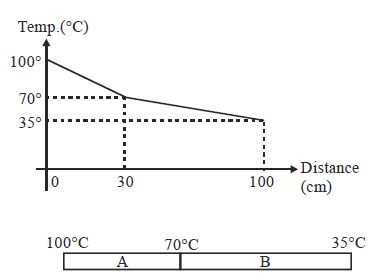
Two different rods $A$ and $B$ are kept as shown in figure. The variation of temperature of different cross sections is plotted in a graph shown in figure. The ratio of thermal conductivities of $A$ and $B$ is
In a system of units if force $(F)$, acceleration $(A) $ and time $(T)$ are taken as fundamental units then the dimensional formula of energy is 
In the following, which one of the diodes reverse biased?
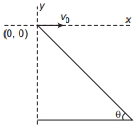
A man standing on a hill top projects a stone horizontally with speed $v_0$ as shown in figure. Taking the coordinates system as given in the figure. The coordinates of the point, where the stone will hit the hill surface are
Two identical dipoles each of magnetic moment $1.0\, A-m^2$ are placed at a separation of $2\,m$ with their axes perpendicular to each other. What is the magnetic field at a point midway between the dipoles ?
The initial activity of a certain radioactive isotope was measured as $16000\ counts\  min^{-1}$. Given that the only activity measured was due to this isotope and that its activity after $12\, h$ was $2000\ counts\ min^{-1}$, its half-life, in hours, is nearest to
A non uniformly shaped conductor is charged then at it's sharpest point