The driver of a bus approaching a big wall notices that the frequency of his bus's horn changes from $420\, Hz$ to $490\, Hz ,$ when he hears it after it gets reflected from the wall. Find the speed of the bus (in $kmh^{-1}$) if speed of the sound is $330\, ms ^{-1}$.
JEE MAIN 2020, Diffcult
Download our app for free and get started
$f _{1}=\left(\frac{330}{330- v _{ B }}\right) 420$
$f _{2}=\left(\frac{330+ v _{0}}{330}\right)\left(\frac{330}{330- v _{ B }}\right) 420$
$490=\left(\frac{330+ v _{ B }}{330- v _{ B }}\right) 420$
$\frac{7}{6}=\frac{330+ v _{ B }}{330- v _{ B }}$
$v _{ B }=\frac{330}{13} m / s$
$=\frac{330}{13} \times \frac{18}{5} \approx 91 km / hr$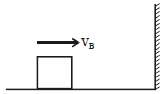

Download our appand get started for free
Experience the future of education. Simply download our apps or reach out to us for more information. Let's shape the future of learning together!No signup needed.*
Similar Questions
- 1A taut string at both ends vibrates in its $n^{th}$ overtone. The distance between adjacent Node and Antinode is found to be $'d'$. If the length of the string is $L,$ thenView Solution
- 2A stretched wire of length $110 cm$ is divided into three segments whose frequencies are in ratio $1 : 2 : 3$. Their lengths must beView Solution
- 3A tuning fork of frequency $512\, Hz$ makes $4$ beats per second with the vibrating string of a piano. The beat frequency decreases to $2$ beats per sec when the tension in the piano string is slightly increased. The frequency of the piano string before increasing the tension was .... $Hz$View Solution
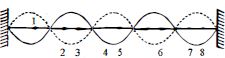
- 4A stretched string is vibrating in its $5^{th}$ harmonic as shown. Consider a particle $1(figure)$. At an instant this particle is at mean positions and is moving towards its negative extreme. Which of the following set of particles, are in same phase with particle $1$View Solution
- 5An open pipe is in resonance in its $2^{nd}$ harmonic with tuning fork of frequency ${f_1}$. Now it is closed at one end. If the frequency of the tuning fork is increased slowly from ${f_1}$ then again a resonance is obtained with a frequency ${f_2}$. If in this case the pipe vibrates ${n^{th}}$ harmonics thenView Solution
- 6If $T$ is the reverberation time of an auditorium of volume $V$ thenView Solution
- 7$Assertion :$ Speed of wave $=\frac{wavelength}{time period}$View Solution
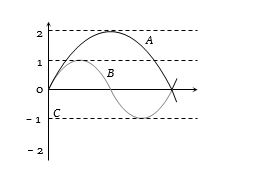
$Reason :$ Wavelength is the distance between two nearest particles in phase. - 8The displacement-time graphs for two sound waves $A$ and $B$ are shown in the figure, then the ratio of their intensities ${I_A}/{I_B}$ is equal toView Solution
- 9A table is revolving on its axis at $5$ revolutions per second. A sound source of frequency $1000 Hz$ is fixed on the table at $70 cm$ from the axis. The minimum frequency heard by a listener standing at a distance from the table will be .... $Hz$ (speed of sound $= 352 m/s$)View Solution
- 10First overtone frequency of a closed organ pipe is equal to the first overtone frequency of an open organ pipe. Further nth harmonic of closed organ pipe is also equal to the mth harmonic of open pipe, where $n$ and $m$ are:View Solution