MCQ
The eccentricity of the hyperbola $5{x^2} - 4{y^2} + 20x + 8y = 4$ is
  • A
    $\sqrt 2 $
  • $\frac{3}{2}$
  • C
    $2$
  • D
    $3$

Answer

Correct option: B.
$\frac{3}{2}$
b
(b) Given equation of hyperbola is $5{x^2} - 4{y^2} + 20x + 8y = 4$

$5{(x + 2)^2} - 4\,{(y - 1)^2} = 20$ ==> $\frac{{{{(x + 2)}^2}}}{4} - \frac{{{{(y - 1)}^2}}}{5} = 1$

From ${b^2} = {a^2}({e^2} - 1)$,   $5 = 4({e^2} - 1)$

$ \Rightarrow {e^2} = 9/4 $

$\Rightarrow e = 3/2$.

Need a full question paper?

Generate a complete, print-ready paper with questions like this in minutes — across 16+ boards, with answer keys.
Start Generating Free

Similar questions

If the two equations ${x^2} - cx + d = 0$ and ${x^2} - ax + b = 0$ have one common root and the second has equal roots, then $2(b + d) = $
A complex number z is said to be unimodular if $\left| z \right| = 1$ . Suppose $z_1$ and $z_2$  are complex number such that $\frac{{{z_1} - 2{z_2}}}{{2 - {z_1}\overline {{z_2}} }}$ is unimodular and  $z_2$ is not unimodular . Then the point $z_1$ lies on a:
Let $PQ$ and $RS$ be the tangent at the extremities of the diameter $PR$ of a circle of radius $r$. If $PS$ and $RQ$ intersect at a point $X$ on the circumference of the circle, then $(PQ.RS)$ is equal to
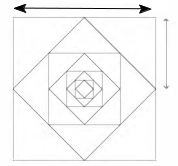
Let $S_1$ be the sum of areas of the squares whose sides are parallel to coordinate axes. Let $S_2$ be the sum of areas of the slanted squares as shown in the figure. Then, $\frac{S_1}{S_2}$ is equal to
The number of ways, $16$ identical cubes, of which $11$ are blue and rest are red, can be placed in a row so that between any two red cubes there should be at least $2$ blue cubes, is
The equation of the tangent at the point $\left( {\frac{{a{b^2}}}{{{a^2} + {b^2}}},\frac{{{a^2}b}}{{{a^2} + {b^2}}}} \right)$ of the circle ${x^2} + {y^2} = \frac{{{a^2}{b^2}}}{{{a^2} + {b^2}}} $ is
A point moves such that its distance from the point $(4,\,0)$is half that of its distance from the line $x = 16$. The locus of this point is
If $a_r$ is the coefficient of $x^{10-r}$ in the Binomial expansion of $(1+x)^{10}$, then $\sum \limits_{r=1}^{10} r^3\left(\frac{a_r}{a_{r-1}}\right)^2$ is equal to
A set contains $(2n + 1)$ elements. The number of sub-sets of the set which contain at most $n$ elements is
Find the distance between (12, 3, 4) and (4, 5, 2):