Question
The efficiency of a Carnot engine for the following temperature differences same is :
(i) 100 K and 500 K
(ii) TK and 900 K
Find the temperature $T$ of the sink.

Answer

Efficiency of engine at first temperature
$\begin{array}{l}\eta_1=\frac{T_1-T_2}{T_1} \\\eta_1=\frac{500-100}{500}=\frac{400}{500}=\frac{4}{5} \\\eta_1=\frac{4}{5}\end{array}$
Let the efficiency of engine at second temperature be $\eta_2$
But
$\begin{array}{l}\eta_2=\frac{900-T}{900} \\\text {But}\quad\eta_1=\eta_2\end{array}$
$\begin{aligned}\therefore \frac{4}{5} & =\frac{900- T }{900} \\ 3600 & =4500-5 T \\\therefore 5 T & =4500-3600=900 \\ T & =\frac{900}{5}=180 K\end{aligned}$

Need a full question paper?

Generate a complete, print-ready paper with questions like this in minutes — across 16+ boards, with answer keys.

Start Generating Free

Similar questions

A car is moving on road with speed 54kmh. What should be the value of torque if the car is brought to rest in 15 seconds? Radius and moment of inertia of wheel about the axis of rotation are 0.35m and 3kgm respectively.

How does the value of g changes with height and depth from earth's surface? Explain by drawing the graph. Or How does the value of acceleration due to gravity change with height above the Earth's surface and with depth from earth's surface?
2 cm from a horizontal pipe of unequal bore. At a point of pressure equal to Hg column, water is flowing out at a velocity of $40 cm / sec$. Calculate the pressure at the point where the velocity of water flow is $60 cm / sec$.
If a drop of water falls on a very hot iron, it does not evaporate for a long time, why?
Write the definitions of longitudinal strain and longitudinal stress.
A disc of mass M and radius r is rotating with an angular velocity $\omega.$ If gently, two masses m are placed at a distance $\frac{\text{r}}{2}$ on either side of the axis, what will be its angular velocity?
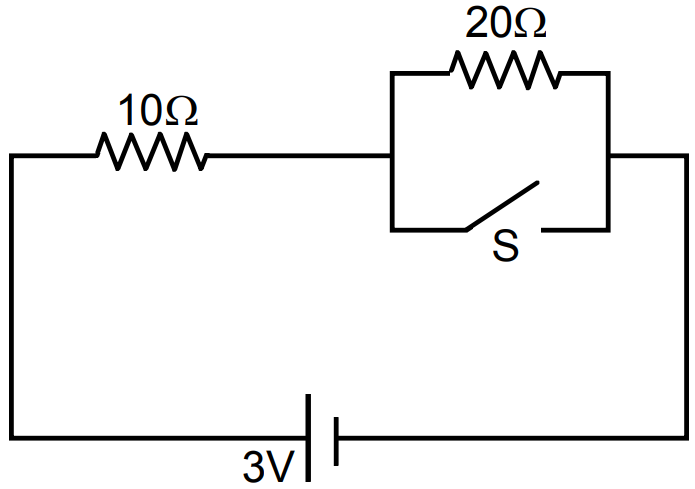
Consider the circuit shown in figure. Find the current through the $10\Omega$ resistor when the switch $S$ is $(a)$ Open $(b)$ Closed.
A Young's double slit apparatus has slits separated by $0.28mm$ and a screen 48cm away from the slits. The whole apparatus is immersed in water and the slits are illuminated by the red light ($\lambda=700\text{nm}$ in vacuum). Find the fringe-width of the pattern formed on the screen.
${ }^{57} \mathrm{Co}$ decays to ${ }^{57} \mathrm{Fe}$ by $\beta^{+}-$emission.- emission. The resulting ${ }^{57} \mathrm{Fe}$ is in its excited state and comes to the ground state by emitting $\gamma$ - rays. The half-life of $\beta^{+}-$ decay is 270 days and that of the $\gamma-$ emissions is $10^{-8} \mathrm{~s}$. A sample of ${ }^{57}$ Co gives $5.0 \times 10^9$ gamma rays per second. How much time will elapse before the emission rate of gamma rays drops to $2.5 \times 10^9$ per second?
You are standing with your bag in your hands, on the ice in the middle of a pond. The ice is so slippery that it can offer no friction. How can you come out of the ice?