Questions

2 Marks Questions

Take a timed test

32 questions · self-marked practice — reveal the answer and mark yourself.

Question 12 Marks
Explain from the first law of thermodynamics why the temperature of a gas falls during adiabatic expansions?
Answer
In adiabatic expansion $\Delta Q=0$
Hence from the first law of thermodynamics $d U =\Delta Q -\Delta W$ but the work in expansion will be done by the gas which will be positive hence dU will be negative.
Since internal energy depends on temperature, the temperature of the gas will fall due to decrease in internal energy.
View full question & answer
Question 22 Marks
A thermos flask is filled with water. The thermos is shaken for some time due to which the temperature of the water increases. Give reasons. (i) Was work done on water? (ii) Was heat given to water? (iii) Will the internal energy of water increases?
Answer
(1) Yes, because the layers of water have to move relative against the viscous force, hence work was done on the water by an external factors.
(ii) No, because the flask is equipped with a heat insulating covers.
(iii) Yes, because due to increase in temperature, uncontrolled movement of molecules results in kinetic energy and due to thermal expansion of water, intermolecular potential energy increases.
View full question & answer
Question 32 Marks
When a bus decends a hilly road at a constant speed, the brake drums become hot, why?
Answer
The kinetic energy of a bus moving at a constant speed remains constant, hence while descending the bus, the gravitational potential energy of the bus gets converted in to internal energy, due to which the brake drums get heated.
View full question & answer
Question 52 Marks
In adiabatic compression of a gas, no heat is supplied to the gas from outside, yet the temperature of gas increases it. Explain the reason.
Answer
In adiabatic compression $\Delta Q =0$ and the work $\Delta W$ is negative (since the volume will decrease) so from the first law of thermodyamics
$\begin{array}{l}dU=\Delta Q-\Delta W \\dU=0-(-\Delta W) \\dU=+\Delta W\end{array}$
i.e. the internal energy will increase, consequently, the temperature of the gas will rise.
View full question & answer
Question 62 Marks
What is meant by cyclic process? Prove that the heat absorbed in cyclic process is equal to the work done by it.
Answer
Cyclic process : When a system returns to its initial state after undergoing any change then it is called cyclic. process. Since internal energy depends on the initial and final conditions of the process. Therefore for a cyclic process,
$\begin{aligned}d U & =0 \\0 & =\Delta Q-\Delta W \\\text {or}\quad\Delta Q & =\Delta W\end{aligned}$
that is, the heat given to a system in a cyclic process is equal to the work done by.
View full question & answer
Question 72 Marks
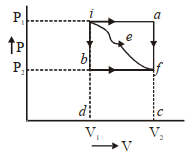
Prove that the work done by a thermodynamic system depend on the path on which the expansion take place.
View full question & answer
Question 82 Marks
Which of the following processes is reversible and which is irreversible?
(i) Isothermal expansion of gas
(ii) Isothermal compression of gas
(iii) Heat flow due to friction
(iv) Heating of resistance by electric current
(v) Flow of heat from hot to cold object
(vi) Carnot engine
(vii)Burst of bicycle tube
(viii) Diffusion of gas
(ix) Slowly strectching or compressing the spring
(x) Exchange of heat between two objects at the same temperature
Answer
(i) Reversible
(ii) Reversible
(iii) Irreversible
(iv) Irreversible
(v) Irreversible
(vi) Reversible
(vii) Irreversible
(viii) Reversible
(ix) Reversible
(x) Reversible
View full question & answer
Question 92 Marks
A Carnot engine works between temperatures $T_1 K$ and $T_2 K$. Prove that to increase its efficiency it will be more effective to reduce the sink temperature to the same value than increasing the source temperature.
Answer
To increase the efficiency of the Carnot engine between tem. $T _1 K$ and $T _2 K$,
$\eta=\left(1-\frac{T_2}{T_1}\right)$
If the temperature of the source $T_1$ is increased by $\Delta T$ then the resulting efficiency will be :
$\begin{aligned}\eta^{\prime} & =1-\frac{T_2}{\left(T_1+\Delta T\right)} \\
& =\frac{T_1+\Delta T-T_2}{T_1+\Delta T}=\frac{T_1-T_2+\Delta T}{T_1+\Delta T}\ldots\ldots (1)\end{aligned}$
The resulting efficiency on subtracting the sink temperature $T _2$ from $\Delta T$,
$\begin{array}{l}\eta^{\prime \prime}=1-\frac{\left(T_2-\Delta T\right)}{T_1} \\\eta^{\prime \prime}=\frac{T_1-T_2+\Delta T}{T_1}\end{array}$
Equation (2) dividing by equation (1)
$\begin{array}{l}\frac{\eta^{\prime \prime}}{\eta^{\prime}}=\frac{T_1+\Delta T }{ T _1}=1+\frac{\Delta T }{ T _1} \\ \frac{\eta^{\prime \prime}}{\eta^{\prime}}>1 \\ \eta^{\prime \prime}>\eta^{\prime}\end{array}$
Instead of increasing the temperature of the source more efficiency is achieved by reducing the temperature of the sink by the same value. It happens.
View full question & answer
Question 102 Marks
A heat engine takes heat $Q_1$ at a temperature of 500 K and gives heat $Q_2$ at a temperature of 300 K to the sink and does $8 \times 10^5$ joules of work. Calculate the magnitude of $Q_1$ and $Q_2$.
Answer
Given that :
$\begin{aligned}T_1 & =500 K \\T_2 & =300 K \\W & =8 \times 10^5 \text { Joule }\end{aligned}$
(i) Heat absorbed from the heat source :
$\begin{aligned}\eta & =\frac{T_1-T_2}{T_1}=\frac{W}{Q_1} \\Q_1 & =\frac{WT_1}{T_1-T_2} \\Q_1 & =\frac{8 \times 10^5 \times 500}{(500-300)} \\Q_1 & =\frac{8 \times 10^5 \times 500}{200}\end{aligned}$
$=20 \times 10^5$ joule
(ii) Dissipated heat
$ \begin{aligned} Q_2 & =Q_1-W \quad\left[\because Q_1-Q_2=W\right] \\ & =20 \times 10^5-8 \times 10^{\frac{5}{3}} \\ & =12 \times 10^5 \text { Joule }\end{aligned} $
View full question & answer
Question 112 Marks
For an engine the sink temperature is 300 K and the source temperature is $T$. If absorbs 200 joules of heat from the source and gives 120 joules of heat to the sink. Find the temperature of the source and efficiency of the engine.
Answer
$\begin{aligned}T_2 & =300 K \\T_1 & =T \text { (Assume) } \\Q_1 & =200 \text { Joule } \\Q_2 & =120 \text { Joule } \\T_1 & =? \\\eta & =?\end{aligned}$
Efficiency of engine
$\begin{aligned}\eta & =\frac{Q_1-Q_2}{Q_1}=\frac{200-120}{200}=\frac{80}{200} \\\eta & =0.4\end{aligned}$
$\text {Therefore,}\quad\eta \%=0.4 \times 100=40 \%$
We know that
$\eta=\frac{T_1-T_2}{T_1}$
$0.4=\frac{T-300}{T}$
$ \begin{array}{l} \Rightarrow \quad 0.4 T=T-300 \\ \Rightarrow \quad 300=T-0.4 T \\ \Rightarrow \quad 300=0.6 T \end{array} $
$\begin{aligned} \Rightarrow \quad T & =\frac{300}{0.6}=\frac{3000}{6}=500 K \\ T & =500 K\end{aligned}$
View full question & answer
Question 122 Marks
The efficiency of a Carnot engine for the following temperature differences same is :
(i) 100 K and 500 K
(ii) TK and 900 K
Find the temperature $T$ of the sink.
Answer
Efficiency of engine at first temperature
$\begin{array}{l}\eta_1=\frac{T_1-T_2}{T_1} \\\eta_1=\frac{500-100}{500}=\frac{400}{500}=\frac{4}{5} \\\eta_1=\frac{4}{5}\end{array}$
Let the efficiency of engine at second temperature be $\eta_2$
But
$\begin{array}{l}\eta_2=\frac{900-T}{900} \\\text {But}\quad\eta_1=\eta_2\end{array}$
$\begin{aligned}\therefore \frac{4}{5} & =\frac{900- T }{900} \\ 3600 & =4500-5 T \\\therefore 5 T & =4500-3600=900 \\ T & =\frac{900}{5}=180 K\end{aligned}$
View full question & answer
Question 132 Marks
An ideal Carnot engine uses an ideal gas. The source temperature is 500 K and the arrival temperature is 375 K . If the engine takes 500 K cal from the source per cycle then estimate (a) efficiency of engine (b) work done per cycle (c) per heat dissipated in bicycle access.
Answer
Given :
$\begin{aligned}T_1 & =500 K \\T_2 & =375 K \\Q_1 & =\text { Heat absorbed per cycle } \\& =500 K \text { cal }\end{aligned}$
(a) Using the relation $\eta=1-\frac{T_2}{T_1}$
$\eta=\frac{T_1-T_2}{T_1}$
Putting the value $\eta=\frac{500-375}{500}$
$\begin{aligned}\eta & =\frac{125}{500}=\frac{1}{4} \\\therefore \quad \eta \% & =\frac{1}{4} \times 100=25 \%\end{aligned}$
(b) Let W be the work done per cycle
$\begin{aligned}\eta & =\frac{Q_1-Q_2}{Q_1}=\frac{W}{Q} \\\therefore \quad \text { or } \quad W & =\eta Q_1 \\W & =0.25 \times 500=125 K cal \ldots\ldots (1)\\W & =125 \times 10^3 \times 4.2 J \\W & =5.25 \times 10^5 J\end{aligned}$
(c) Let $Q_2=$ heat expelled in the approach
$\begin{array}{ll}\therefore & W=Q_1-Q_2 \\\therefore & Q_2=Q_1-W\end{array}$
[Putting value from equation (1)]
$Q_2=500-125=375 Kcal$
View full question & answer
Question 142 Marks
A gas is suddenly compressed from its original volume to a volume of $1 / 4$. Estimate the temperature, the original temperature is 300 K and $\gamma= 1 . 5$.
Answer
 $ \begin{aligned}\text {Suppose}\quad\quad V_1 & =\text { Initial volume } \\ V_2 & =\text { Final volume }=\frac{V_1}{4} \\ \frac{V_1}{V_2} & =4 \quad \therefore \frac{V_2}{V_1}=\frac{1}{4} \\ T_1 & =300 K, T_2=? \\ \gamma & =1.5 \end{aligned} $
We know that for adiabatic change :
$\begin{aligned}T _1 V_1{ }^{\gamma-1} & = T _2 V_2^{\gamma-1} \\ \text{or}\quad \frac{T_1}{T_2} & =\left(\frac{ V _2}{V_1}\right)^{\gamma-1} \\\text {or}\quad \frac{300}{T_2} & =\left(\frac{1}{4}\right)^{1.5-1}=\left(\frac{1}{4}\right)^{0.5} \\ \text {or}\quad\frac{300}{T_2} & =\frac{1}{2} \quad \therefore T_2=600 K\end{aligned}$
Hence the increase in temperature
$\begin{array}{l}=T_2-T_1 \\ =600-300=300 K\end{array}$
View full question & answer
Question 152 Marks
Heat is transferred from inside a refrigerator at 287 K to a room at 310 K ideally, how much heat (in joules) will be given to the room by the expenditure of each joule of electrical energy?
Answer
Given that :
$\begin{aligned}T_2 & =287 K \\T_1 & =310 K \\Q_1 & =? \\W & =1 J\end{aligned}$
$\begin{array}{l}\text {Using the relation :}\quad\alpha=\frac{T_2}{T_1-T_2} \\\alpha=\frac{287}{310-287}=\frac{287}{23} \\\text {We get}\quad\quad\alpha=12.48\end{array}$
$\begin{array}{l}\text {We also know that}\quad\alpha=\frac{Q_2}{W}=\frac{Q_2}{1} \\\alpha=Q_2\end{array}$
$\therefore \quad Q_2=12.48 J$
$\text {$\therefore$ Now}\quad W=Q_1-Q_2$
$\text {or}\quad Q_1=W+Q_2$
Total heat supplied to the room :
$\begin{array}{l}Q_1=1+12.48 \\Q_1=13.48 J\end{array}$
View full question & answer
Question 162 Marks
What will be the value of the coefficient and performance of $a$ Carnot refrigerant oprating between $40^{\circ} C$ and $0^{\circ} C$ ?
Answer
$\begin{array}{l}T_2=0^{\circ} C=273 K \\T_1=40^{\circ} C=273+40=313 K \\\alpha=?\end{array}$
Using the relation $\alpha=\frac{T_2}{T_1-T_2}$
$\begin{array}{l}\alpha=\frac{273}{313-273}=\frac{273}{40} \\\alpha=6.825\end{array}$
$\therefore$ We get $\alpha \simeq 6.835$
View full question & answer
Question 172 Marks
An average of 265J of heat is transferred per second by a refrigerant at temperatures from$23^{\circ}\text C $ to $27^{\circ}\text C. $ Estimate the average suitable power assuming one ideal reversible cycle and not taking in to account any other losses.
Answer
 Given that :
$\begin{array}{l}T_1=27+273=300 K \\T_2=-23+273=250 K \\Q_2=265 J / s\end{array}$
$\text {We know that}\quad\quad\frac{Q_1}{Q_2}=\frac{T_1}{T_2}$
$\text {or}\quad\quad Q_1=\left(\frac{T_1}{T_2}\right) \times Q_2$
$\begin{aligned}\text {Putting the value}\quad \quad Q_1 & =\frac{300}{250} \times 265 \\& =\frac{6}{5} \times 265 \\& =6 \times 53=318 J / S\end{aligned}$
$\therefore$ Suitable average power
$\begin{array}{l}=Q_1-Q_2 \\=318-265 \\=53 W\end{array}$
View full question & answer
Question 182 Marks
A gas having volume of 1 liter at 80 cm mercury pressure expands to 1.190 liter in the adiabatic process. If the pressure of the gas is $6 2 . 6 ~ c m$ and it falls to then find the value of $\gamma$.
Answer
Given that :
$\begin{aligned}P_1 & =80 cm \\P_2 & =62.6 cm \\V_1 & =1 \text { litre } \\V_2 & =1.190 \text { litre }\end{aligned}$
For adiabatic change
$P _1 V_1^\gamma= P _2 V_2^\gamma$
or $\quad\left(\frac{ V _1}{V_2}\right)^\gamma=\left(\frac{ P _2}{ P _1}\right)$
$\begin{aligned}\text {or}\quad\quad\gamma\left(\log V_{1}-\log V_2\right) & =\log P_2-\log P_1 \\\gamma & =\frac{\log P_2-\log P_1}{\log V_1-\log V_2} \\& =\frac{\log 62.6-\log 80}{\log 1-\log 1.190} \\& =\frac{1.7966-1.9031}{0-0.0755}=\frac{0.1065}{0.0755} \\\gamma & =1.41\end{aligned}$
View full question & answer
Question 192 Marks
At a pressure of $10^5 N / m ^2$ the volume of one cubic meter of gas expands and doubles. Find the value of work done: (i) at constant pressure (ii) constant temperature.
Answer
Given that :
$\begin{aligned}V_1 & =1 m^3 \\P_1 & =10^5 Newton / m^2 \\V_2 & =2 m^3\end{aligned}$
(i) At static pressure
$W=P d V$
$W=10^5(2-1)=10^5 \text { Joule }$
(ii) At static temperature : So we know that, work done at static pressure is :
$\begin{array}{l}W=2.303 RT \log _{10} \frac{V_2}{V_1} \\W=2.303 P_1 V_1 \log _{10} \frac{V_2}{V_1}\left[\because P_1 V_1=P_2 V_2=RT\right] \\\begin{aligned}W & =2.303 \times 10^5 \times 1 \log _{10} \frac{2}{1} \\W & =2.303 \times 10^5 \times 0.3010 \\& =6.93 \times 10^4 Joule\end{aligned} \quad \begin{aligned}\end{aligned} \begin{aligned}&\end{aligned} \end{array}$
View full question & answer
Question 202 Marks
A diatomic gas is suddenly compressed to 1/4 of its initial volume. Find the ratio of final and initial pressure $(\gamma = 1.5)$.
Answer
Given :
$V_2=\frac{1}{4} V_1$
$\text {And} \quad \gamma=1.5$
$\text {We know that} \quad P_1 V_1^\gamma=P_2 V_2^\gamma$
$\begin{array}{l}\text { or } \quad \frac{P_2}{P_1}=\left(\frac{V_1}{V_2}\right)^\gamma=\left(\frac{V_1}{\frac{1}{4} V_1}\right)^{1.5} \\\frac{P_2}{P_1}=(4)^{1.5}=4 \times 2 \\\frac{P_2}{P_1}=\frac{8}{1} \\\therefore P_2: P_1\quad=8: 1\end{array}$
View full question & answer
Question 212 Marks
0.1 mole of nitrogen gas is heated from $27^{\circ} C$ to $327^{\circ} C$ at atmospheric pressure. Find the heat given, work done by the gas and change in internal energy of the gas. For nitrogen $C_r=6.93$ and $C_v=4.96$ $cal / mol /{ }^{\circ} C$.
Answer
Given :
$\begin{aligned}n & =0.1 \text { Mole } \\\Delta T & =327^{\circ}-27^{\circ} C=300^{\circ} C \\C_p & =6.93 \text { Calories } / mole^{-1}{ }^{\circ} C^{-1} \\C_v & =4.96 \text { Calories } / mole^{-1}{ }^{\circ} C^{-1} \\\text { Given heat } \quad \Delta Q & =n C_p \Delta T\end{aligned}$
$\begin{array}{l}=0.1 \times 6.93 \times 300^{\circ} C =207.9 \\ =208 \text { Approx. calorie }\end{array}$
$ \begin{array}{l}\text {Work done by gas} =P d V \\\quad\quad\quad\quad\quad\quad\quad\quad =n R \Delta T \\\quad\quad\quad\quad\quad\quad\quad\quad =n\left(C_p-C_v\right) \Delta T \\\quad\quad\quad\quad\quad\quad\quad\quad =0.1(6.93-4.96) \times 300 \\\quad\quad\quad\quad\quad\quad\quad\quad =0.1 \times 1.97 \times 300 \\\quad\quad\quad\quad\quad\quad\quad\quad =59.1 \text { calorie } \end{array} $
Change the gas in initial energy
$ \begin{aligned} dU & =\Delta Q-\Delta W \\ & =207.9-59.1 \\ & =148.8 \text { calorie } \end{aligned} $
View full question & answer
Question 222 Marks
Considering a household refrigerator as a reversible engine operating between the melting point of ice and room temperature $27^{\circ} C$, estimate the energy provided joules ( $J$ ) to freeze 1 kg of water, the temperature of water is given in $0^{\circ} C , L = 8 0 Cal g ^{-1}$.
Answer
Given that :
$\begin{aligned}T_1 & =27+273=300 K \\T_2 & =0+273=273 K \\m & =1 kg=1000 g, L=80 calg^{-1} \\\text { Melting energy } \quad Q_2 & =m \times L \\& =1000 \times 80 cal=8 \times 10^4 cal\end{aligned}$
Using the relation
$\begin{aligned}\frac{Q_1}{Q_2} & =\frac{T_1}{T_2} \\Q_1 & =\left(\frac{T_1}{T_2}\right) \times Q_2=\frac{300}{273} \times 8 \times 10^4 \\& =8.79 \times 10^4\end{aligned}$
Desired deliverable energy
$\begin{aligned}W & =Q_1-Q_2 \\W & =8.79 \times 10^4-8 \times 10^4 \\& =0.79 \times 10^4 cal \\& =7.9 Kcal .\end{aligned}$
View full question & answer
Question 232 Marks
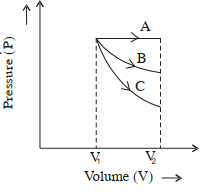
Write the reason why the slope of the adiabatic curve is greater than the slope of the isothermal curve.
Answer
For the same decrease in pressure, the volume increase in adiabatic expansion of a gas is less than that in isothermal expansion, because the temperature of the gas falls in adiabatic expansion. Therefore, the slope of the adiabatic curve $\frac{\Delta P }{\Delta V }$ is more.
View full question & answer
Question 242 Marks
Explain the isobaric process.
Answer
Isobaric process : The process on which the pressure of the system remains constant i.e. $P =$ constant is called isobaric process. Change of state of Liquids (solid to liquid, liquid to gas or vice versa) is an example of isobaric process. If the volume $V _1$ changes to $V _2$ in the process, then the work done by the gas is:
$\begin{array}{l}\Delta W =\int_{ V _1}^{ V _2} P d V= P \int_{ V _1}^{ V _2} d V \\ \Delta W = P \left( V _2- V _1\right)\end{array}$
From first law of thermodynamics
$\Delta Q =d U + P \left( V _2- V _1\right)$
View full question & answer
Question 252 Marks
The heat capacities of the source and the sink should be infinite. Why so?
Answer
The heat capacity of the heat source should be infinite so that the heat taken by the heat engine does not heat the source and its temperature remains constant. The heat capacity of the sink should also be infinite so that its temperature does not increase due to the heat given up by the heat engine and remains constant.
View full question & answer
Question 262 Marks
Mentioning the shortcomings of the first law of thermodynamic, explain the need for the second law.
Answer
Inadequacy of the first rule
Demerits of the first law : (i) It does not have knowledge of the direction of action. It happens, for example, when brakes are used to stop a car, the work done against the frictional forces is converted in to heat and the car stops. But when the car cools down why is the same heat not converted in to kinetic energy of the car and why does the car not start moving again? This type of answer is not known from the first rule.
(ii) The efficiency of energy conversion is not known. A heat engine converts heat in to mechanical work. But why no engine can convert the heat absorbed from the source in to 100% work? The answer to this question is also not available from the first law of thermodynamics.
Therefore, to acquire knowledge of whether an action occurs or not and the direction in which that action occurs, other rules are required which is called the second law of thermodyamics.
View full question & answer
Question 272 Marks
Calculate the specific heat of a system for isothermal process.
Answer
Changes in system occur at constant temperature. When heat is applied to a system, both the pressure and volume changes.
Let the change in pressure be dP and change in volume dV by giving quantity of heat dQ, then
From the first low of thermodynamic
$\begin{array}{l}d Q =d U + P d V \\ d Q = C _{ v } d T+ P d V \\ d T=0 \\ d Q = P d V\end{array}$
In this transformation the heat given to the system is used only for doing external work. In this change the value of change in internal energy of the system is zero or the internal energy remains constant. That is dU = 0 or U = constant, the value of specific heat in isothermal change of a substance is infinite.
That is $
S_{\text {isechermal }}=\infty
$
Since we know
Specific heat $( s )=\frac{ Q }{m \times \Delta T }$
But $
\Delta T=0
$
$\therefore \quad$ Specific heat $=\frac{ Q }{m \times 0}=\infty$
View full question & answer
Question 282 Marks
Which has more internal energy among solid, liquid and gas of equal mass at the same temperature?
Answer
We know that internal energy is internal kinetic energy + internal potential energy. For the same mass at the same temperture, the internal kinetic enegy of all states matter remains the same. Intermolecular forces of attraction are found to be the strongest in solids. Therefore in solids the internal potential energy is negative and its magnitude is found to be the highest, whereas in gases the intermolecular forces is found to be negligible. Therefore the internal potential energy of a gas is found to be zero. Therefore, the internal energy of a gas is highest for the same mass at the same temperature.
View full question & answer
Question 292 Marks
From the first law of thermodynamics prove the following relation for the isovoluemetric process of one gram mole ideal gas.
$\Delta Q=C_v d T$
Where $C _{ v }$ is the molecular constant volume versus heat in grams.
Answer
In isovolumetric process the volume of the system remains unchanged that is dV = 0, hence from the first rule
$\begin{aligned} \Delta Q & =d U +\Delta W \\ \Delta Q & =d U + P d V \\ \Delta Q & =d U \quad \because d V=0\end{aligned}$
Therefore, the heat given in this process is used in the form of increase in internal energy (increase in temperature also). If the specific heat per gram molecule is $C_V$ while keeping the volume constant, then the heat required to increase the temperature of one gram molecule of gas is
$\Delta Q = C _{ v } d T$
View full question & answer
Question 302 Marks
Define reversible and irreversible actions and write one example of each.
Answer
Reversible action : Such action after completion of which the system and its surroundings return to its original state, is called reversible action. In this process the remaining source and sink remain unaffected.
Example: carnot engine.
Irreversible action : Any action which is not reversible is called irreversible action. This cannot be done in the opposite direction.
Example : Conduction, radiation and so on.
View full question & answer
Question 312 Marks
Why is the value of $C _{ P }$ greater than $C _{ v }$ ?
Answer
$C_P-C_V=R$
$C _{ P }> C _{ V }$
That is, $C _{ p }> C _{ v }$, this happens because the heat given at a fixed volume is used only in increasing the temperature, the work in this process is zero.
$[\Delta W = PdV =0]$
Whereas the heat given at constant pressure is used for both temperature increase and work. Therefore it happens the value of $C _{ p }$ is greater than $C _{ V }$
View full question & answer
Question 322 Marks
What is meant by thermal equilibrium?
Answer
Thermal equilibrium state is that state of a system in which its thermodynamic coordinates, pressure, volume, temperature etc. remain unchanged with time. For example, consider a gas filled in a container with solid insulating walls that is completely isolated from the atmosphere. This system (i.e. gas) is not able to exchange any kind of energy with the environment due to which its pressure, volume, temperature etc. remain constant and the system remains in a state of thermal equilibrium.
View full question & answer