MCQ
The efficiency of Carnot engine when source temperature is $T_1$ and sink temperature is $T_2$ will be
  • $\frac{{{T_1} - {T_2}}}{{{T_1}}}$
  • B
    $\frac{{{T_2} - {T_1}}}{{{T_2}}}$
  • C
    $\frac{{{T_1} - {T_2}}}{{{T_2}}}$
  • D
    $\frac{{{T_1}}}{{{T_2}}}$

Answer

Correct option: A.
$\frac{{{T_1} - {T_2}}}{{{T_1}}}$
a
(a) Efficiency of Carnot engine $=\eta=\frac{T_{1}-T_{2}}{T_{1}}$

where, $T_{1}=$ source temperature

$T_{2}=$ sink temperature

Need a full question paper?

Generate a complete, print-ready paper with questions like this in minutes — across 16+ boards, with answer keys.
Start Generating Free

Similar questions

A sample of an ideal gas occupies a volume $V$ at a pressure $P$ and absolute temperature $T,$ the mass of each molecule is $m.$ The expression for the density of gas is ($k =$ Boltzmann’s constant)
Which of the following statements is not true ? In the case of a simple pendulum for small amplitudes the period of oscillation is
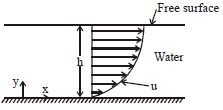
For the situation shown in the figure, water flows on the surface of a fixed plate. The
velocity of water as a function of distance $'y'$ is given as : $u = \alpha \left[ {\frac{y}{h} - 2{{\left( {\frac{y}{h}} \right)}^2}} \right]$ . Determine the magnitude of the shear stress that the water applies at the base of the plate. Coefficient of viscosity is $\eta$
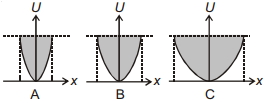
The variations of potential energy $(U)$ with position $x$ for three simple harmonic oscillators $A, B$ and $C$ are shown in figure. The oscillators have same mass. The time period of oscillation is greatest for
Cooking is difficult on hills because:
Two point masses of mass $m_1 = fM$ and $m_2 = (1 -f)\,M\,(f < 1 )$ are in outer space ( far from gravitational influence of other objects) at a distance $R$ from each other. They move in circular orbits about their centre of mass with angular vaocities $\omega _1$ for $m_1$ and $\omega _2$ for $m_2.$ In that case
Speed $v$ of a particle moving along a straight line, when it is at a distance $x$ from a fixed point on the line is given by $v^2 = 108 - 9x^2$ (all quantities in $S.I.$ unit). Then
For a periodic motion represented by the equation $Y=\sin \omega t+\cos \omega t$ The amplitude of the motion is 
Consider the following two statements
$1.$ Linear momentum of a system of particles is zero
$2.$ Kinetic energy of a system of particles is zeroThen
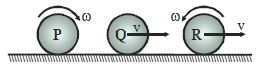
Three solid spheres are made to move on a rough horizontal surface. Sphere $P$ is given a spin and released. Sphere $Q$ is given a forward linear velocity. Sphere $R$ is given linear and rotational motions as shown in the figure. Directions of the friction force on spheres $P, Q, R$ are respectively