MCQ
The Einstein’s photo$-$electric equation is based upon the conservation of:
  • A
    Mass
  • B
    Momentum
  • C
    Angular momentum
  • Energy

Answer

Correct option: D.
Energy

Einsteins photoelectric equations states that
$E_k$ ​= hν − $\phi$
where, $E_k$​ is maximum kinetic energy of emitted photoelectrons
$h$ is plank's constant.
$ν$ is frequency of incident light
$\phi$ is work function of metal.
So, it is clearly based upon energy conservation.

Need a full question paper?

Generate a complete, print-ready paper with questions like this in minutes — across 16+ boards, with answer keys.
Start Generating Free

Similar questions

The velocity of photon is proportional to (where $v$ is frequency)
Which of the following curves gives correct graphical representation between refracting index $\mu $ of glass and wavelength $\lambda $ of light
If a charged spherical conductor of radius 10 cm has potential V at a point distant 5 cm from its centre, then the potential at a point distant 15 cm from the centre will be 
In an $H-$ like atom when electron transits from energy state $n=5$ to $n=2$ , a photon of wavelength $434\,nm$ is emitted. What will be the wavelength of photon emitted when the transition occurs from energy state $n=4$ to $n=2$ ?.......$nm$
The AC voltage across a resistance can be measured using:
The de-Broglie wavelength of electron in $3^{\text {rd }}$ orbit of $\mathrm{He}^{+1}$ ion is approximately.
Two incident monochromatic waves whose wavelengths differ by a small amount $d\lambda$ are separated angularly at $\theta$ and $\theta + d\theta$ $w.r.t$. the incidence ray. The dispersive power is given by
The activity of a radioactive sample is 1.6 curie and its half-life is 2.5 days. Its activity after 10 days will be
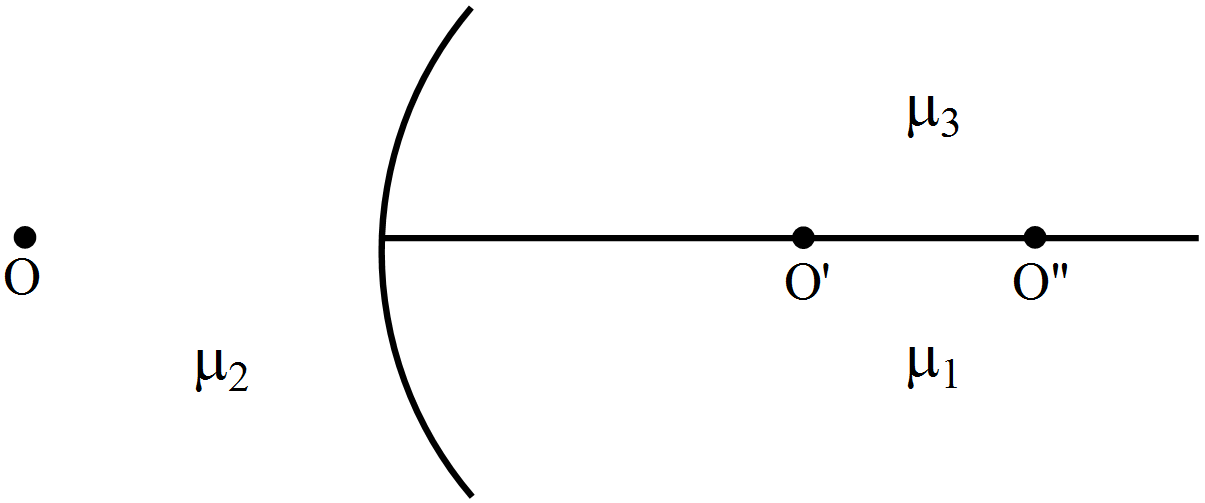
Three transparent media of refractive indices $\mu_1,\mu_2$ and $\mu_3.$ A point object $O$ is placed in the medium $\mu_2.$ If the entire medium on the right of the spherical surface has refractive index $\mu_1,$ the image forms at $O'$. If this entire medium has refractive index $\mu_3,$ the image forms at $O"$. In the situation shown:

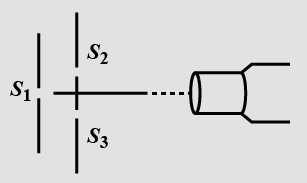
A student is asked to measure the wavelength of monochromatic light. He sets up the apparatus as shown. $S_1, S_2, S_3$ are narrow parallel slits. $L$ is radiant lamps and $M$ is a micrometer eyepiece. The student fails to observe interference fringes. We would advice him to: