Question
The electric field associated with a monochromatic beam becomes zero 1.2 × 1015 times per second. Find the maximum kinetic energy of the photoelectrons when this light falls on a metal surface whose work function is 2.0eV.

Answer

 The electric field becomes 01.2 × 1045 times per second.

$\therefore$ Frequency $=\frac{1.2\times10^{15}}{2}=0.6\times10^{15}$

$\text{hv}=\phi_0+\text{kE}$

$\Rightarrow\text{hv}-\phi_0=\text{KE}$

$\Rightarrow\text{KE}=\frac{6.63\times10^{-34}\times0.6\times10^{15}}{1.6\times10^{-19}}-2$

$=0.482\text{ev}=0.48\text{ev.}$

Need a full question paper?

Generate a complete, print-ready paper with questions like this in minutes — across 16+ boards, with answer keys.
Start Generating Free

Similar questions

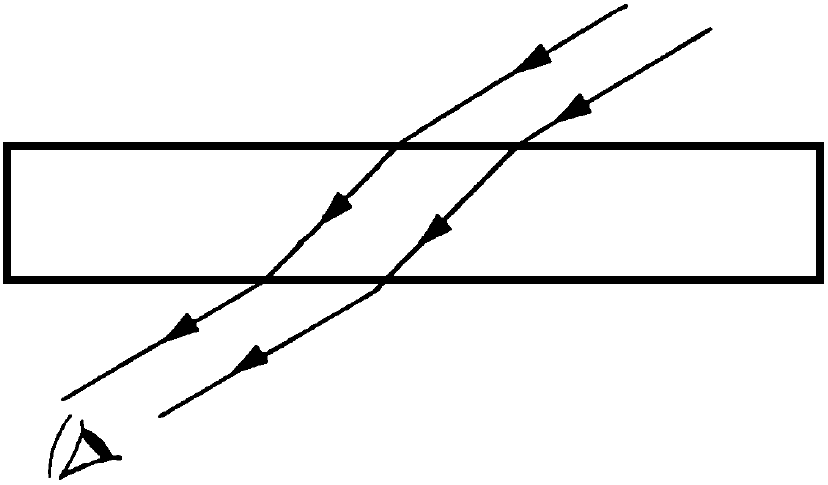
A narrow beam of light passes through a slab obliquely and is then received by an eye. The index of refraction of the material in the slab fluctuates slowly with time. How will it appear to the eye? The twinkling of stars has a similar explanation.

The number of electrons in an insulator is of the same order as the number of electrons in a conductor. What is then the basic difference between a conductor and an insulator?
A 1000 MW fission reactor consumes half of its fuel in 5.00 y. How much $^{235}_{92}\text{U}$ did it contain initially? Assume that the reactor operates 80% of the time, that all the energy generated arises from the fission of $^{235}_{92}\text{U}$ and that this nuclide is consumed only by the fission process.
State Biot – Savart law. Deduce the expression for the magnetic field at a point on the axis of a current carrying circular loop of radius ‘R’, distant ‘x’ from the centre. Hence write the magnetic field at the centre of a loop.
The electric current in an X-ray tube (from the target to the filament) operating at 40kV is 10mA. Assume that on an average, 1% of the total kinetic energy of the electron hitting hte target are converted into X-rays.
  1. What is the total power emitted as X-rays
  2. How much heat is produced in the target every second?
Suppose Swarglok (heaven) is in constant motion at a speed of 0.9999c with respect to the earth. According to the earth's frame, how much time passes on the earth before one day passes on Swarglok?
Derive $\frac{n_1}{-u}+\frac{n_2}{v}=\frac{n_2-n_1}{ R }$ for refraction at a spherical surface.
  1. How are electromagnetic waves produced? Explain.
  2. A plane electromagnetic wave is travelling through a medium along the +ve z-direction. Depict the electromagnetic wave showing the directions of the oscillating electric and magnetic fields.
One end of a cylindrical glass rod $(\mu=1.5)$ of radius 1.0cm is rounded in the shape of a hemisphere. The rod is immersed in water $\Big(\mu=\frac{4}{3}\Big)$ and an object is placed in the water along the axis of the rod at a distance of 8.0cm from the rounded edge. Locate the image of the object.
A person travels on a spaceship moving at a speed of $\frac{5\text{c}}{13}$
  1. Find the time interval calculated by him between the consecutive birthday celebrations of his friend on the earth.
  2. Find the time interval calculated by the friend on the earth between the consecutive birthday celebrations of the traveller.