15 questions · timed · auto-graded
$\therefore$ E in 1sec = 10J
% used to convert into photon = 60%
$\therefore$ Energy used = 6J
Energy used to take out 1 photon
$=\frac{\text{hc}}{\lambda}=\frac{6.63\times10^{-34}\times3\times10^{8}}{590\times10^{-9}}=\frac{6.633}{590}\times10^{-17}$
No. of photons used
$=\frac{6}{\frac{6.63\times3}{590}\times10^{-17}}=\frac{6\times590}{6.63\times3}\times10^{17}$
$=176.9\times10^{17}=1.77\times10^{19}$
We get,
$\frac{\text{hc}}{\lambda}+\text{m}_0\text{c}^2=\text{mc}^2$and applying conservation of momentum
$\frac{\text{h}}{\lambda}=\text{mv}$Mass of e
$=\text{m}=\frac{\text{m}_0}{\sqrt{1-\frac{\text{v}^2}{\text{c}^2}}}$from above equation it can be easily shown that
V = C
V = 0
both of these results have no physical meaning hence it is not possible for a photon to be completely absorbed by a free electron.
$\text{Energy}=\frac{\text{kq}^2}{\text{R}}=\frac{\text{kq}^2}{1}$
Now,
$\frac{\text{kq}^2}{1}=\frac{\text{hc}}{\lambda}$$\lambda=\frac{\text{hc}}{\text{kq}^2}$
For max
$'\lambda',$ ‘q’ should be min,For minimum ‘e’ = 1.6 × 10⁻¹⁹C
$\text{Max}\lambda=\frac{\text{hc}}{\text{kq}^2}=0.863\times10^3=863\text{m.}$
For next smaller wavelength
$=\frac{6.63\times3\times10^{-34}\times10^{8}}{9\times10^9\times(1.6\times2)^2\times10^{-38}}$
$\frac{863}{4}=215.74\text{m}$
$\therefore$ Frequency $=\frac{1.2\times10^{15}}{2}=0.6\times10^{15}$
$\text{hv}=\phi_0+\text{kE}$
$\Rightarrow\text{hv}-\phi_0=\text{KE}$
$\Rightarrow\text{KE}=\frac{6.63\times10^{-34}\times0.6\times10^{15}}{1.6\times10^{-19}}-2$
$=0.482\text{ev}=0.48\text{ev.}$
$\text{E}=\text{mc}^2$
$\Rightarrow\text{E}=\frac{\text{m}_0\text{c}^2}{\sqrt{1\frac{\text{v}^2}{\text{c}^2}}}$
Relativistic momentum,
$\text{p}=\text{mv}$
$\Rightarrow\text{p}=\frac{\text{m}_0\text{c}^2}{\sqrt{1\frac{\text{v}^2}{\text{c}^2}}}$
Combining the above equations, we get:
$\text{E}^2=\text{m}_0^2\text{c}^ 4+\text{p}^2\text{c}^2$
From the above equation, it is clear that for
$\text{p}=\frac{\text{E}}{\text{c}}$ to be valid, the rest mass of the body should be zero. As electrons do not have zero rest mass, this equation is not valid for electrons.Stopping potential or energy
$=\text{E}-\phi=\frac{\text{wc}}{\lambda}-\phi$
Minimum 1.7V is necessary to stop the electron
The minimum K.E. = 2eV
[Since the electric potential of 2V is reqd. to accelerate the electron to reach the plates]
The maximum K.E. = (2 + 1, 7)ev = 3.7ev.
$=\frac{5\times10^{-3}}{8\times10^{15}}-1.6\times10^{-19}\times2$
(Given V0 = 2V, No. of photons = 8 × 10¹⁵, Power = 5mW)$=6.25\times10^{-19}-3.2\times10^{-19}=3.05\times10^{-19}\text{J}$
$=\frac{3.05\times10^{-19}}{1.6\times10^{-19}}=1.906\text{ev.}$

$\text{p}=\frac{\text{h}}{\lambda}$
$\text{E}=\frac{\text{hc}}{\lambda}=\text{pc}$
$\Rightarrow\frac{\text{E}}{\text{t}}=\frac{\text{p}}{\text{t}}\text{c}$
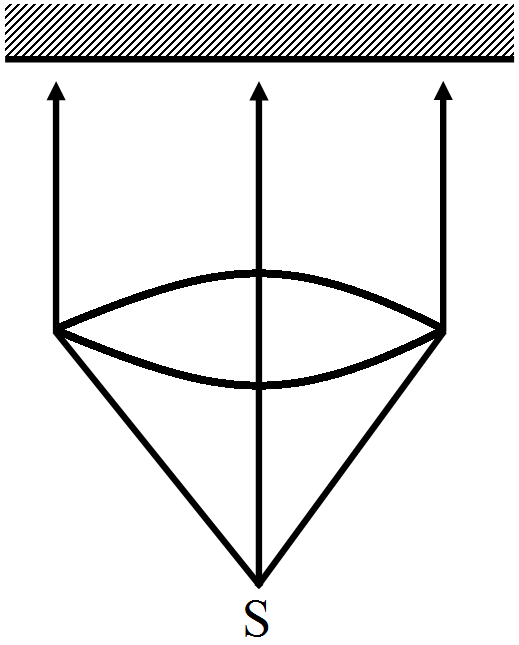
⇒ Rate of change of momentum $=\frac{\text{power}}{\text{C}}$ 30% of light passes through the lens. Thus it exerts force. 70% is reflected.$\therefore$ Force exerted = 2(rate of change of momentum)
$=2\times\frac{\text{power}}{\text{C}}$
$30\%\Big(\frac{2\times\text{power}}{\text{C}}\Big)=\text{mg}$
$\Rightarrow\text{power}=\frac{20\times10^{-3}\times10\times3\times10^{8}\times10}{2\times3}$
$=10\text{W}=100\text{MW.}$
$\text{pc}=\sqrt{\text{E}^2-\text{m}^2\text{c}^4.}$
A photon has zero rest mass. Therefore, on putting m = 0 in the equation, we get
$\text{p}=\frac{\text{E}}{\text{c}},$ which is the valid equation for a photon.$\text{v}_0=\frac{\text{W}_0}{\text{h}}=\frac{2.5\times10^{-19}}{6.63\times10^{-34}}$
$=3.77\times10^{14}\text{Hz}=3.8\times10^{14}\text{Hz}$
or,
$\text{v}_0=\frac{\text{hv}-\text{W}_0}{\text{e}}$$=\frac{6.63\times10^{-34}\times6\times10^{14}-2.5\times10^{-19}}{1.6\times10^{-19}}=0.91\text{v}$
$\text{E}=\text{hv}=\frac{\text{hv}}{\lambda}$
$\text{h}=6.63\times10^{-34}\text{j}-\text{s}$
$\text{c}=3\times10^8\text{m/s},\lambda_1=400\text{nm},\lambda_2=780\text{nm}$
$\text{E}_1=\frac{6.6.3\times10^{-34}\times3\times10^8}{400\times10^{-9}}$
$=\frac{6.63\times3}{4}\times10^{-19}=5\times10^{-19}\text{J}$
$\text{E}_2=\frac{6.63\times3}{7.8}\times10^{-19}=2.55\times10^{-19}\text{J}.$
So, the range is $5\times10^{-19}\text{J}\text{ to }2.55\times10^{-19}\text{J}.$
Now,
$\text{Force}=\frac{\text{power}}{\text{velocity}}=\frac{60}{3\times10^8}=2\times10^{-7}\text{N}.$$\text{pressure}=\frac{\text{force}}{\text{area}}=\frac{2\times10^{-7}}{4\times3.14\times(0.2)^2}$
$\frac{1}{8\times3.14}\times10^{-5}$
$=0.039\times10^{-5}=3.9\times10^{-7}=4\times10^{-7}\text{N/m}^2.$