Question
The electric field E due to a point charge at any point near it is defined as $\text{E} = \DeclareMathOperator*{\median}{\text{lim}} \median_{\text{q}\rightarrow0}\frac{\text{F}}{\text{q}}$ where q is the test charge and F is the force acting on it. What is the physical significance of $\DeclareMathOperator*{\median}{\text{lim}} \median_{\text{q}\rightarrow0}$ in this expression? Draw the electric field lines of a point charge Q when (a) Q>0 and (b) Q<0. 
Answer

Get the step-by-step solution for this question inside the Vidyadip app.

Get the answer in the app

Need a full question paper?

Generate a complete, print-ready paper with questions like this in minutes — across 16+ boards, with answer keys.

Start Generating Free

Similar questions

Draw the graph of variation of Coulomb force (F) with $(r)$. Where the distance between the two charges of each charge pair is ( $1 \mu C , 2 \mu C$ ) and ( $2 \mu C$, $-3 \mu C$ ). Analyse the graph obtained.
Define intensity of electric field at any point. Write down its S.I. unit.
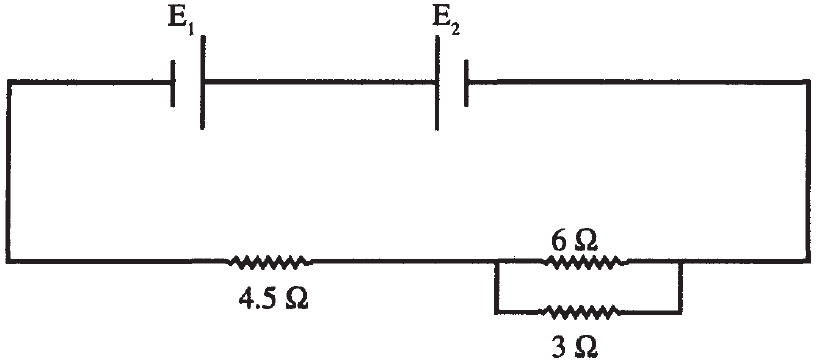
Two cells E1and E2 in the given circuit diagram have an emf of 5 V and 9 V and internal resistance of  0.3 $\Omega$ and 1.2 $\Omega$ respectively.

Calculate the value of current flowing through the resistance of  3 $\Omega$.

When a nucleus at rest emits a beta particle, it is found that the velocities of the recoiling nucleus and the beta particle are not along the same straight line. How can this be possible in view of the principle of conservation of momentum?
Answer the following question:
As you have learnt in the text, the principle of linear superposition of wave displacement is basic to understanding intensity distributions in diffraction and interference patterns. What is the justification of this principle?
A cell whose electromotive force is 2 volt and internal resistance 0.1 is joined with an external resistance of 3,9 . Find the terminal voltage of the cell.
A current carrying loop consists of 3 identical quarter circles of radius R, lying in the positive quadrants of the x-y, y-z and z-x planes with their centres at the origin, joined together. Find the direction and magnitude of B at the origin.
Half-life time of a radioactive element is 10 years. In how much time it will be left (1/16)th of its original mass ?
Is neutral temperature always the arithmetic mean of inversion temperature and the temperature of the cold junction? Does the unit of temperature have an effect in deciding this question?
Define the term ‘Half-life’ of a radioactive substance. Two different radioactive substances have half-lives T1 and T2 and number of undecayed atoms at an instant N1 and N2, respectively. Find the ratio of their activities at that instant.