Question
The electric field E due to a point charge at any point near it is defined as $\text{E} = \DeclareMathOperator*{\median}{\text{lim}} \median_{\text{q}\rightarrow0}\frac{\text{F}}{\text{q}}$ where q is the test charge and F is the force acting on it. What is the physical significance of $\DeclareMathOperator*{\median}{\text{lim}} \median_{\text{q}\rightarrow0}$ in this expression? Draw the electric field lines of a point charge Q when (a) Q>0 and (b) Q<0.
Answer

Get the step-by-step solution for this question inside the Vidyadip app.

Get the answer in the app

Need a full question paper?

Generate a complete, print-ready paper with questions like this in minutes — across 16+ boards, with answer keys.

Start Generating Free

Similar questions

As temperature increases, the viscosity of liquids decreases considerably. Will this decrease the resistance of an electrolyte as the temperature increases?
What is the principle of superposition of charges?
A filter transmits only the radiation of wavelength greater than 440nm. Radiation from a hydrogen-discharge tube goes through such a filter and is incident on a metal of work function 2.0eV. Find the stopping potential which can stop the photoelectrons.
Can there be a potential difference between two adjacent conductors carrying the same charge?
Write the definition of electric current and ampere $(A)$ and different units of electric current.
The coil of a moving-coil galvanometer keeps on oscillating for a long time if it is deflected and released. If the ends of the coil are connected together, the oscillation stops at once. Explain
What is mass defect? Explain binding energy of the nucleus and the binding energy per nucleon.
$\#\#\#$ Explain binding energy of nucleus.
An ammeter of resistance 0.80 $\Omega$ can measure current up to 1.0 A.
  1. What must be the value of shunt resistane to enable the ammeter to measure current upto 5.0 A?
  2. What is the combined resistance of the ammeter and the shunt?
A metal sphere of radius 1mm and mass 50mg falls vertically in glycerine. Find:
  1. The viscous force exerted by the glycerine on the sphere when the speed of the sphere is 1cm/s.
  2. The hydrostatic force exerted by the glycerine on the sphere and.
  3. The terminal velocity with which the sphere will move down without acceleration. Density of glycerine = $1260kg/m^3$ and its coefficient of viscosity at room temperature = 8.0 poise.
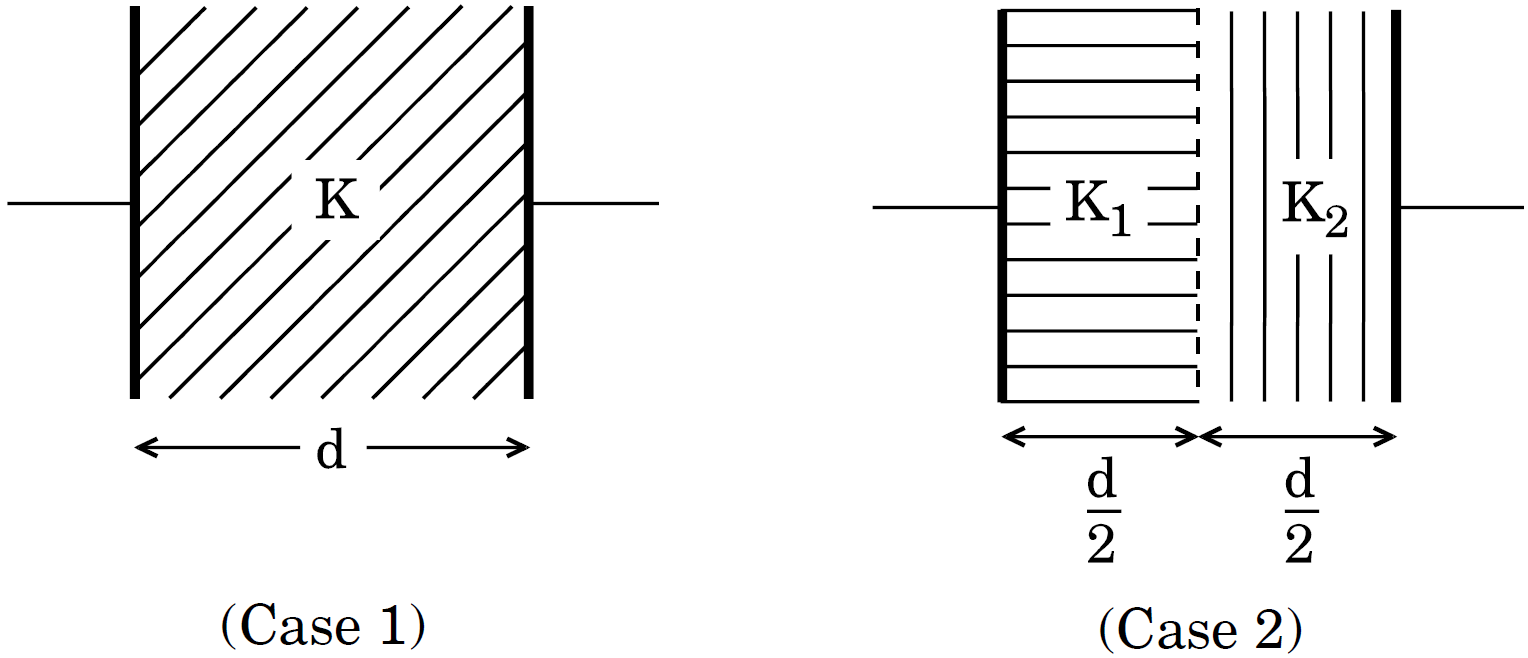
The space between the plates of a parallel plate capacitor is completely filled in two ways. In the first case, it is filled with a slab of dielectric constant K . In the second case, it is filled with two slabs of equal thickness and dielectric constants $\mathrm{K}_1$ and $\mathrm{K}_2$ respectively as shown in the figure. The capacitance of the capacitor is same in the two cases. Obtain the relationship between $\mathrm{K}, \mathrm{K}_1$ and $\mathrm{K}_2$.