MCQ
The electric field in a region is given $\overrightarrow{ E }=\left(\frac{3}{5} E _{0} \hat{ i }+\frac{4}{5} E _{0} \hat{ j }\right) \frac{ N }{ C } .$ The ratio of flux of reported field through the rectangular surface of area $0.2\, m ^{2}$ (parallel to $y - z$ plane) to that of the surface of area $0.3\, m ^{2}$ (parallel to $x - z$ plane $)$ is $a : b ,$ where $a =$ .............

[Here $\hat{ i }, \hat{ j }$ and $\hat{ k }$ are unit vectors along $x , y$ and $z-$axes respectively]

  • A
    $2$
  • B
    $3$
  • C
    $4$
  • $1$

Answer

Correct option: D.
$1$
d
$\overrightarrow{ E }=\left(\frac{3 E _{0}}{5} \hat{ i }+\frac{4 E _{0}}{5} \hat{ j }\right) \frac{ N }{ C }$

$A_{1}=0.2 m ^{2}$ [parallel to $y - z$ plane $]$

$=\overrightarrow{ A }_{1}=0.2 m ^{2} \hat{ i }$

$A_{2}=0.3 m ^{2}$ [parallel to $x - z$ plane $]$

$\overrightarrow{ A }_{2}=0.3 m ^{2} \hat{ j }$

Now $\phi_{a}=\left[\frac{3 E_{0}}{5} \hat{i}+\frac{4 E_{0}}{5} \hat{j}\right] \cdot[0.2 \hat{i}]=\frac{3 \times 0.2}{5} E _{0}$

$\phi_{b}=\left[\frac{3 E_{0}}{5} \hat{i}+\frac{4 E_{0}}{5} \hat{j}\right] \cdot[0.3 \hat{j}]=\frac{4 \times 0.3}{5} E _{0}$

$\operatorname{Now} \frac{\phi_{ a }}{\phi_{ b }}=\frac{0.6}{1.2}=\frac{1}{2}=\frac{ a }{ b }$

$\Rightarrow a: b=1: 2$

$\Rightarrow a=1$

Need a full question paper?

Generate a complete, print-ready paper with questions like this in minutes — across 16+ boards, with answer keys.

Start Generating Free

Similar questions

By photoelectric effect, Einstein, proved
The minimum energy required to remove an electron is called
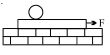
$A$ plank with a uniform sphere placed on it rests on a smooth horizontal plane. Plank is pulled to right by $a$ constant force $F$. If sphere does not slip over the plank. Which of the following is incorrect.
The amplitude of $15 \sin (1000 \pi t )$ is modulated by $10 \sin (4 \pi t)$ signal. The amplitude modulated signal contains frequencies of

$1.$ $500\,Hz$.  $2.$ $2\,Hz$  $3.$ $250\,Hz$  $4.$ $498\,Hz$  $5.$ $502\,Hz$

Choose the correct answer from the options given below:

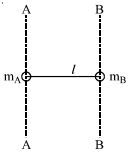
$A$ point mass $m_A$ is connected to a point mass $m_B$ by a massless rod of length $l$ as shown in the figure. It is observed that the ratio of the moment of inertia of the system about the two axes $BB$ and $AA$, which is parallel to each other and perpendicular to the rod is $\frac{{{I_{BB}}}}{{{I_{AA}}}}=3$. The distance of the centre of mass of the system from the mass $A$ is
A particle of mass $m$ and charge $q$ is thrown from origin at $t = 0$ with velocity $2\hat{i}$ + $3\hat{j}$ + $4\hat{k}$ units in a region with uniform magnetic field $\vec B$ = $2\hat{i}$ units. After time $t =\frac{{\pi m}}{{qB}}$ , an electric field  is switched on such that particle moves on a straight line with constant speed. $\vec E$ may be
A parallel plate capacitor of capacitance $C$ is connected to a battery and is charged to a potential difference $V$. Another capacitor of capacitance $2C$ is connected to another battery and is charged to potential difference $2V$. The charging batteries are now disconnected and the capacitors are connected in parallel to each other in such a way that the positive terminal of one is connected to the negative terminal of the other. The final energy of the configuration is
When the velocity of body is variable, then
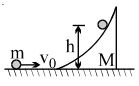
A particle of mass $m$ moving horizontally with $v_0$ strikes $a$ smooth wedge of mass $M$, as shown in figure. After collision, the ball starts moving up the inclined face of the wedge and rises to $a$ height $h$. Choose the correct statement(s) related to particle $m$ 
According to Joule's law, if the potential difference across a conductor having a material of specific resistance remains constant, then the heat produced in the conductor is directly proportional to