MCQ
The minimum energy required to remove an electron is called
  • A
    Stopping potential
  • B
    Kinetic energy
  • Work function
  • D
    None of these

Answer

Correct option: C.
Work function
c
(c) Work function is the minimum energy required to just remove the electron from lattice$/$atom.

Need a full question paper?

Generate a complete, print-ready paper with questions like this in minutes — across 16+ boards, with answer keys.

Start Generating Free

Similar questions

If the kinetic energy of a free electron doubles, its de-Broglie wavelength changes by the factor
A heavy nucleus at rest breaks into two fragments which fly off with velocities in the ratio $8 : 1$. The ratio of radii of the fragments is
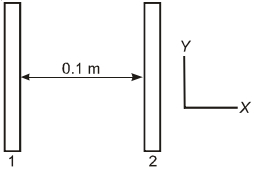
Two insulating plates are both uniformly charged in such a way that the potential difference between them is $V_2 - V_1 = 20\ V$. (i.e., plate $2$ is at a higher potential). The plates are separated by $d = 0.1\ m$ and can be treated as infinitely large. An electron is released from rest on the inner surface of plate $1. $ What is its speed when it hits plate $2?$
$(e = 1.6 \times 10^{-19}\ C, m_e= 9.11 \times 10^{-31}\ kg)$
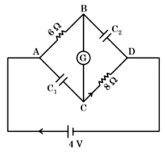
In this figure the resistance of the coil of galvanometer $G$ is $2\,\Omega$. The emf of the cell is $4\,V$. The ratio of potential difference across $C_1$ and $C_2$ is:
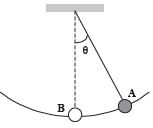
A ball attached to one end of a string swings in a vertical plane such that its acceleration at point $A$ (extreme position) is equal to its acceleration at point $B$ (mean position). The angle $\theta$ is :-
$X-$ rays were discovered by
At constant volume, temperature is increased. Then
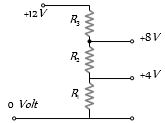
A potential divider is used to give outputs of $4\, V$ and $8\, V$ from a $12\, V$ source. Which combination of resistances, $(R_1, R_2, R_3)$ gives the correct voltages ? $R_1 : R_2 : R_3$
The following three objects $(1)$ a metal tray, $(2)$ a block of wood and $(3)$ a woolen cap are left in a closed room overnight. Next day, the temperature of each is recorded as $T_1, T_2$ and $T_3$, respectively. The likely situation is
In a circuit for finding the resistance of a galvanometer by half deflection method, a  $6\,V$  battery and a high resistance of  $11\,k\Omega $  are used. The figure of merit of the galvanometer $60\,\mu A/$  division. In the absence of shunt resistance, the galvanometer produces a deflection of  $\theta = 9$  divisions when current flows in the circuit. The value of the shunt resistance that can cause the deflection of $\theta /2 ,$  is closest to ..................  $\Omega$