Question
The Electric flux through the surface:

Answer

  1. Is the same for all the figures.
Key concept: According to Gauss' law of electrostatics, the total electric flux out of a closed surface is equal to the charge enclosed divided by the permittivity,
$\text{i.e.,}\phi=\frac{\text{Q}_\text{enclosed}}{\epsilon_0}$
Thus, electric flux through a surface doesn't depend on the shape, size or area of a surface but it depends on the amount of charge enclosed by the surface.
In given figures the charge enclosed are same that means the electric flux through all the surfaces should be the same. Hence option (d) is correct.

Need a full question paper?

Generate a complete, print-ready paper with questions like this in minutes — across 16+ boards, with answer keys.
Start Generating Free

Similar questions

The magnifying power of a microscope with an objective of 5 mm focal length is 400. The length of its tube is 20 cm. Then the focal length of the eye-piece is (a) 200 cm(b) 160 cm  (c) 2.5 cm(d)  0.1 cm  
       
In a Young's double slit experiment, the fringe width will remain same, if (D = distance between screen and plane of slits, d = separation between two slits and λ =  wavelength of light used) (a) Both λ and D are doubled(b) Both d and D are doubled(c) D is doubled but d is halved(d) λ  is doubled but d is halved
   
   
In a triode valve (a) If the grid voltage is zero then plate current will be zero(b) If the temperature of filament is doubled, then the thermionic current will also be doubled(c) If the temperature of filament is doubled, then the thermionic current will nearly be four times(d) At a definite grid voltage the plate current varies with plate voltage according to Ohm’s law


Consider the following two statements regarding a linearly polarised, plane electromagnetic wave$:$
  1. The electric field and the magnetic field have equal average values.
  2. The electric energy and the magnetic energy have equal average values.
Equal torques act on the discs $A$ and $B$ of the previous problem, initially both being at rest. At a later instant, the linear speeds of a point on the rim of $A$ and another point on the rim of $B$ are $v_A$ and $v_B$ respectively. We have:
An under water swimmer is at a depth of 12 m below the surface of water.  A bird is at a height of 18 m from the surface of water, directly above his eyes.  For the swimmer the bird appears to be at a distance from the surface of water equal to (Refractive Index of water is 4/3)(a) 24 m   (b) 12 m(c) 18 m(d) 9 m
       
The capacitance of a spherical condenser is 1μF. If the spacing between the two spheres is 1mm, then the radius of the outer sphere is(a) 30 cm(b) 6 m(c) 5 cm  (d) 3 m
       
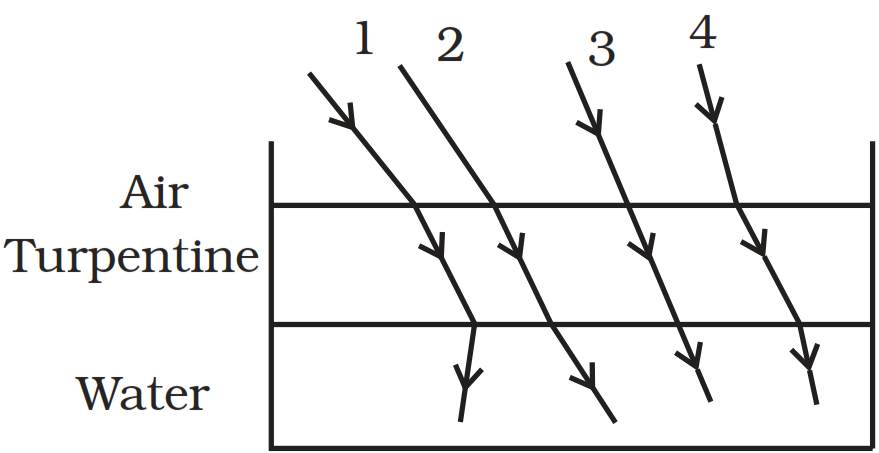
The optical density of turpentine is higher than that of water while its mass density is lower. Fig. shows a layer of turpentine floating over water in a container. For which one of the four rays incident on turpentine in Fig, the path shown is correct?
A moving coil galvanometer has a resistance of 50 Ω and gives full scale deflection for 10 mA. How could it be converted into an ammeter with a full scale deflection for 1A(a) 50/99 Ω  in series(b) 50/99 Ω in parallel(c) 0.01 Ω in series(d) 0.01 Ω in parallel
   
   
Suppose a container ia evacuated to leave just one molecule of a gas in it. Let $V_a$ and $v_{\text{rms}}$ represent the average speed and the $\text{rms}$ speed of the gas.