MCQ
The Electric flux through the surface:
- AIn Fig. 1.3 (iv) is the largest.
- BIn Fig. 1.3 (iii) is the least.
- CIn Fig. 1.3 (ii) is same as Fig. 1.3 (iii) but is smaller than Fig. 1.3 (iv)
- DIs the same for all the figures.
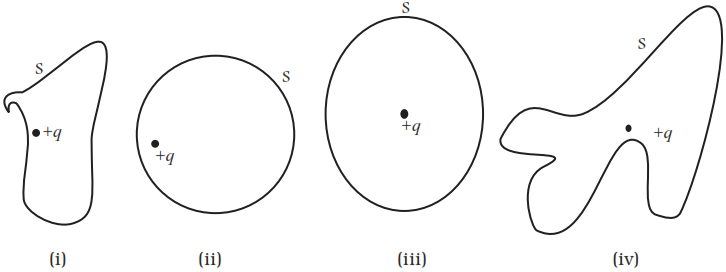
Key concept: According to Gauss' law of electrostatics, the total electric flux out of a closed surface is equal to the charge enclosed divided by the permittivity,
$\text{i.e.,}\phi=\frac{\text{Q}_\text{enclosed}}{\in_0}$
Thus, electric flux through a surface doesn't depend on the shape, size or area of a surface but it depends on the amount of charge enclosed by the surface.
In given figures the charge enclosed are same that means the electric flux through all the surfaces should be the same. Hence option (d) is correct.
Generate a complete, print-ready paper with questions like this in minutes — across 16+ boards, with answer keys.
 electrons reach the anode per second. If the power consumed is 448 milliwatts, then the plate (anode) voltage is
|
(a) 150 V |
(b) 200V |
(c) 14 × 448 V |
(d) 448/14V |
An electron of mass m when accelerated through a potential difference V has de-Broglie wavelength λ. The de-Broglie wavelength associated with a proton of mass M accelerated through the same potential difference will be
|
(a) λ |
(b) λ |
(c) λ |
(d) λ |
Magnetic moments of two bar magnets may be compared with the help of
| (a) Deflection magnetometer | (b) Vibration magnetometer |
| (c) Both of the above | (d) None of the above |
A parallel plate air capacitor has a capacitance of 100 μμF. The plates are at a distance d apart. If a slab of thickness t( t ≤ d) and dielectric constant 5 is introduced between the parallel plates, then the capacitance will be
|
(a) 50 μμF |
(b) 100 μμF |
(c) 200 μμF |
(d) 500 μμF |
Equal charges are given to two spheres of different radii. The potential will
|
(a) Be more on the smaller sphere |
|
(b) Be more on the bigger sphere |
|
(c) Be equal on both the spheres |
|
(d) Depend on the nature of the materials of the spheres |
Current provided by a battery is maximum when
|
(a) Internal resistance equal to external resistance |
|
(b) Internal resistance is greater than external resistance |
|
(c) Internal resistance is less than external resistance |
|
(d) None of these |


