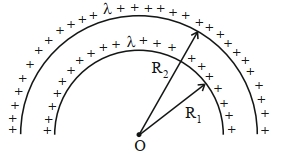
The electric potential at the centre of two concentric half rings of radii $R_1$ and $R_2$, having same linear charge density $\lambda$ is
JEE MAIN 2023, Diffcult


Download our appand get started for free
Experience the future of education. Simply download our apps or reach out to us for more information. Let's shape the future of learning together!No signup needed.*
Similar Questions
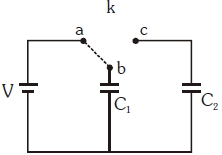
- 1Two Identical capacttors $\mathrm{C}_{1}$ and $\mathrm{C}_{2}$ of equal capacitance are connected as shown in the circult. Terminals $a$ and $b$ of the key $k$ are connected to charge capacitor $\mathrm{C}_{1}$ using battery of $emf \;V\; volt$. Now disconnecting $a$ and $b$ the terminals $b$ and $c$ are connected. Due to this, what will be the percentage loss of energy?.....$\%$View Solution
- 2Two charged parallel plate capacitors, each with separation between plates equal to $d$, are separated by a large distance $L >> d$. Then the force of interaction between them is proportional toView Solution
- 3A parallel plate capacitor having a plate separation of $2\, mm$ is charged by connecting it to a $300\, V$ supply. The energy density is.....$J/m^3$View Solution
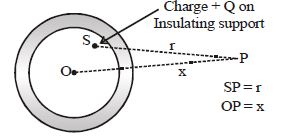
- 4The adjacent diagram shows a charge $+Q$ held on an insulating support $S$ and enclosed by a hollow spherical conductor. $O$ represents the centre of the spherical conductor. and $P$ is a point such that $OP = x $ and $SP = r$ . The electric field at point $P$ will beView Solution
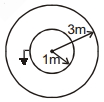
- 5Figure shows a solid conducting sphere of radius $1 m$, enclosed by a metallic shell of radius $3 \,m$ such that their centres coincide. If outer shell is given a charge of $6 \,\mu C$ and inner sphere is earthed, find magnitude charge on the surface of inner shell is ............. $\mu C$View Solution
- 6The distance between two plates of a capacitor is $d$ and its capacitance is $C _1$, when air is the medium between the plates. If a metal sheet of thickness $\frac{2 d }{3}$ and of same area as plate is introduced between the plates, the capacitance of the capacitor becomes $C _2$. The ratio $\frac{ C _2}{ C _1}$ is:View Solution
- 7If an $\alpha$-particle and a proton are accelerated from rest by a potential difference of 1 megavolt then the ratio of their kinetic energy will beView Solution
- 8A variable condenser is permanently connected to a $100$ $V$ battery. If the capacity is changed from $2\,\mu \,F$ to $10\,\mu \,F$, then change in energy is equal toView Solution
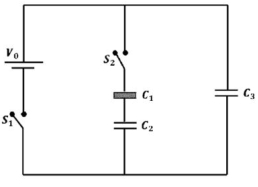
- 9. Three identical capacitors $C _1, C _2$ and $C _3$ have a capacitance of $1.0 \mu F$ each and they are uncharged initially. They are connected in a circuit as shown in the figure and $C _1$ is then filled completely with a dielectric material of relative permittivity $\varepsilon_{ r }$. The cell electromotive force (emf) $V_0=8 V$. First the switch $S_1$ is closed while the switch $S_2$ is kept open. When the capacitor $C_3$ is fully charged, $S_1$ is opened and $S_2$ is closed simultaneously. When all the capacitors reach equilibrium, the charge on $C _3$ is found to be $5 \mu C$. The value of $\varepsilon_{ r }=$. . . . .View Solution
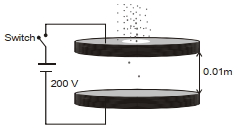
- 10Two large circular discs separated by a distance of $0.01 m$ are connected to a battery via a switch as shown in the figure. Charged oil drops of density $900 kg m ^{-3}$ are released through a tiny hole at the center of the top disc. Once some oil drops achieve terminal velocity, the switch is closed to apply a voltage of $200 V$ across the discs. As a result, an oil drop of radius $8 \times 10^{-7} m$ stops moving vertically and floats between the discs. The number of electrons present in this oil drop is (neglect the buoyancy force, take acceleration due to gravity $=10 ms ^{-2}$ and charge on an electron ($e$) $=1.6 \times 10^{-19} C$ )View Solution