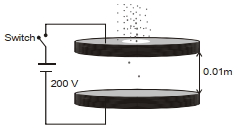
Two large circular discs separated by a distance of $0.01 m$ are connected to a battery via a switch as shown in the figure. Charged oil drops of density $900 kg m ^{-3}$ are released through a tiny hole at the center of the top disc. Once some oil drops achieve terminal velocity, the switch is closed to apply a voltage of $200 V$ across the discs. As a result, an oil drop of radius $8 \times 10^{-7} m$ stops moving vertically and floats between the discs. The number of electrons present in this oil drop is (neglect the buoyancy force, take acceleration due to gravity $=10 ms ^{-2}$ and charge on an electron ($e$) $=1.6 \times 10^{-19} C$ )
IIT 2020, Medium
Download our app for free and get started
$E =\frac{ V }{ d }=\frac{200}{0.01}=2 \times 10^4 V / m$
When terminal velocity is achieved
$qE = mg$
$\Rightarrow n \times 1.6 \times 10^{-19} \times 2 \times 10^4=\frac{4 \pi}{3}\left(8 \times 10^{-7}\right)^3 \times 900 \times 10$
$\Rightarrow n \approx 60$

Download our appand get started for free
Experience the future of education. Simply download our apps or reach out to us for more information. Let's shape the future of learning together!No signup needed.*
Similar Questions
- 1Three infinitely long linear charges of charge density $\lambda $ , $\lambda $ and $-2\lambda $ are placed in space. A point in space is specified by its perpendicular distance $r_1 , r_2 $ and $ r_3$ respectively from the linear charges. For the points which are equipotentialView Solution
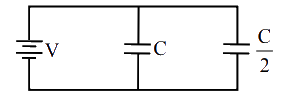
- 2Two condensers, one of capacity $C$ and other of capacity $C/2$ are connected to a $V-$ volt battery, as shown in the figure. The work done in charging fully both the condensers isView Solution
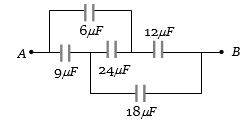
- 3In the connections shown in the adjoining figure, the equivalent capacity between $A$ and $B$ will be......$\mu F$View Solution
- 4$27$ identical drops are charged at $22\, V\,\,each.$ They combine to form a bigger drop. The potential of the bigger drop will be............ $V.$View Solution
- 5Three capacitors of $2\,\mu F,\,3\,\mu F$ and $6\,\mu F$ are joined in series and the combination is charged by means of a $24\, volt$ battery. The potential difference between the plates of the $6\,\mu F$ capacitor is.......$volt$View Solution
- 6A parallel plate condenser has a capacitance $50\,\mu F$ in air and $110\,\mu F$ when immersed in an oil. The dielectric constant $'k'$ of the oil isView Solution
- 7Two capacitors $C_1$ and $C_2$ are connected in a circuit as shown in figure. The potential difference $(V_A -V_B)$ is....$V$View Solution
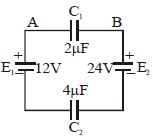
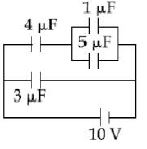
- 8In the given circuit, the charge on $4\, \mu F$ capacitor will be.....$\mu C$View Solution
- 9A $4\, \,\mu F$ condenser is charged to $400\, V$ and then its plates are joined through a resistance. The heat produced in the resistance is.......$J$View Solution
- 10If $q$ is the charge per unit area on the surface of a conductor, then the electric field intensity at a point on the surface isView Solution