Question
The electric potential is measured in:

Answer

  1. Volt.

Need a full question paper?

Generate a complete, print-ready paper with questions like this in minutes — across 16+ boards, with answer keys.
Start Generating Free

Similar questions

According to the Heisenberg uncertainty principle:
Pick the correct options.
Light of frequency $8\times 10^{15} Hz$ is incident on a substance of photoelectric work function $6.125\ eV.$ The maximum kinetic energy of the emitted photoelectrons is
In the Young's double slit experiment, the ratio of intensities of bright and dark fringes is 9. This means that(a) The intensities of individual sources are 5 and 4 units respectively(b) The intensities of individual sources are 4 and 1 units respectively(c) The ratio of their amplitudes is 2(d) b, c


In an LCR series a.c. circuit, the voltage across each of the components. L, C and R is 50V. The voltage across the LC combination will be:
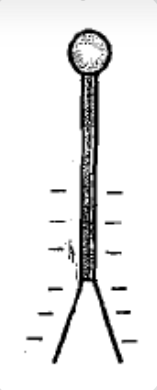
The adjoining figure shows a negatively charged electroscope. If a negatively charged rod is brought close to, but not touching, the knob, the two leaves will:
Two thin lenses whose powers are +2D and –4D respectively combine, then the power of combination is(a) – 2D(b) + 2D(c) – 4D    (d) + 4D
       
Which of the following have highest specific charge(a) Positron(b) Proton(c) He(d) None of these
       
Assertion   :  In a simple battery circuit the point of lowest potential is positive terminal of the battery
Reason      : The current flows towards the point of the higher potential as it flows in such a circuit from the negative to the positive terminal.
The distance of closest approach of an alpha particle is $d$ when it moves with a speed $V$ towards a nucleus.
Another alpha particle is projected with higher energy such that the new distance of the closest approach is $d/2$ . What is the speed of projection of the alpha particle in this case?