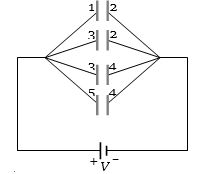
Five identical plates each of area $A$ are joined as shown in the figure. The distance between the plates is $d$. The plates are connected to a potential difference of $V\;volts$. The charge on plates $1$ and $4$ will be
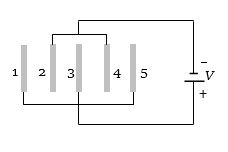
IIT 1984, Diffcult


Download our appand get started for free
Experience the future of education. Simply download our apps or reach out to us for more information. Let's shape the future of learning together!No signup needed.*
Similar Questions
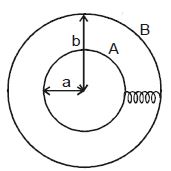
- 1Two spherical conductors $A$ and $B$ of radii $a$ and $b$ $(b > a)$ are placed concentrically in air. The two are connected by a copper wire as shown in figure. Then the equivalent capacitance of the system isView Solution
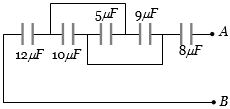
- 2The capacities and connection of five capacitors are shown in the adjoining figure. The potential difference between the points $A$ and $B$ is $60\;volts$. Then the equivalent capacity between $A$ and $B$ and the charge on $5\,\mu F$ capacitance will be respectivelyView Solution
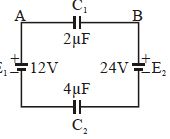
- 3Two capacitors $C_1$ and $C_2$ are connected in a cirucit as shown in figure. The potential difference $(V_A -V_B)$ is.....$V$View Solution
- 4Four point charges $-Q, -q, 2q$ and $2Q$ are placed, one at each comer of the square. The relation between $Q$ and $q$ for which the potential at the centre of the square is zero isView Solution
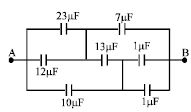
- 5Find the equivalent capacitance across $A$ and $B$......$\mu F$View Solution
- 6A parallel plate capacitor with plate separation $5$ $\mathrm{mm}$ is charged up by a battery. It is found that on introducing a dielectric sheet of thickness $2 \mathrm{~mm}$, while keeping the battery connections intact, the capacitor draws $25 \%$ more charge from the battery than before. The dielectric constant of the sheet is_____.View Solution
- 7The electric potential $V$ is given as a function of distance $x$ (metre) by $V = (5{x^2} + 10x - 9)\,volt$. Value of electric field at $x = 1$ is......$V/m$View Solution
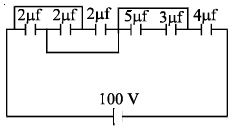
- 8In the circuit shown in figure charge stored in the capacitor of capacity $5\ \mu f$ is......$ \mu C$View Solution
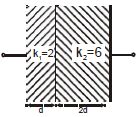
- 9View SolutionA parallel plate capacitor has two layers of dielectrics as shown in fig. This capacitor is connected across a battery, then the ratio of potential difference across the dielectric layers is
- 10If ${q}_{{f}}$ is the free charge on the capacitor plates and ${q}_{{b}}$ is the bound charge on the dielectric slab of dielectric constant $k$ placed between the capacitor plates, then bound charge $q_{b}$ can be expressed asView Solution