Question

The electrical circuits used to get smooth d.c. output from a rectifier circuit is called

(a) Filter

(b) Amplifier

(c) Full wave rectifier

(d) Oscillator

Answer

(b) Amplifier

Need a full question paper?

Generate a complete, print-ready paper with questions like this in minutes — across 16+ boards, with answer keys.

Start Generating Free

Similar questions

The ionization potential for second He electron is

(a) 13.6 eV

(b) 27.2 eV

(c) 54.4 eV

(d) 100 eV

When no current is passed through a conductor?

The electric resistance of a certain wire of iron is R. If its length and radius are both doubled, then

(a) The resistance will be doubled and the specific resistance will be halved

(b) The resistance will be halved and the specific resistance will remain unchanged

(c) The resistance will be halved and the specific resistance will be doubled

(d) The resistance and the specific resistance, will both remain unchanged

A 6kHz sinusoidal voltage is applied to a series RC circuit. The frequency of the voltage across the resistor is.

The phenomena involved in the reflection of radiowaves by ionosphere is similar to:

The electric field due to a uniformly charged sphere of radius R as a function of the distance from its centre is represented graphically by

(a)

(b)

(c)

(d)

The oscillating electric and magnetic vectors of an electromagnetic wave are oriented along:

Which of the following logic gate is an universal gate

(a) OR

(b) NOT

(c) AND

(d) NOR

Assertion  :  There is no current in the metals in the absence of electric field.

Reason      : Motion of free electron are randomly.

(a) If both assertion and reason are true and the reason is the correct explanation of the assertion.

(b) If both assertion and reason are true but reason is not the correct explanation of the assertion.

(c) If assertion is true but reason is false.

(d) If the assertion and reason both are false.

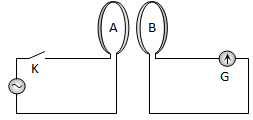
The diagram below shows two coils A and B placed parallel to each other at a very small distance. Coil A is connected to an ac supply. G is a very sensitive galvanometer. When the key is closed

(a) Constant deflection will be observed in the galvanometer for 50 Hz supply

(b) Visible small variations will be observed in the galvanometer for 50 Hz input

(c) Oscillations in the galvanometer may be observed when the input ac voltage has a frequency of 1 to 2 Hz

(d) No variation will be observed in the galvanometer even when the input ac voltage is 1 or 2 Hz