MCQ
The electromagnetic waves travel with a velocity
  • A
    Equal to velocity of sound
  • Equal to velocity of light
  • C
    Less than velocity of light
  • D
    None of these

Answer

Correct option: B.
Equal to velocity of light
Velocity of EM waves $=\frac{1}{\sqrt{\mu_0 \in_0}} 3 \times 10^8 m / s =$ velocity of light

Need a full question paper?

Generate a complete, print-ready paper with questions like this in minutes — across 16+ boards, with answer keys.
Start Generating Free

Similar questions

The angle between the two vectors $\vec{A}=3 \hat{i}+4 \hat{j}+5 \hat{k}$ and $\vec{B}=3 \hat{i}+4 \hat{j}-5 \hat{k}$ will be
When light falls on a metal surface, the maximum kinetic energy of the emitted photo-electrons depends upon
A mercury drop of $1 \mathrm{~cm}$ radius is broken into $10^6$ small drops. The energy used will be (surface tension of mercury is $\left.35 \times 10^{-3} \mathrm{~N} / \mathrm{cm}\right)$
A ball hits a vertical wall horizontally at $10 \mathrm{~m} / \mathrm{s}$ bounces back at $10 \mathrm{m} / \mathrm{s}$
An object is projected with a velocity of $20 m / s$ making an angle of 45 with horizontal. The equation for the trajectory is $h=A x-B x$ where $h$ is height, $x$ is horizontal distance, $A$ and $B$ are constants. The ratio $A: B$ is $(g=10 ms )$
The displacement $x$ (in metres) of a particle performing simple harmonic motion is related to time $t$ (in seconds) as $x=0.05 \cos \left(4 \pi t+\frac{\pi}{4}\right)$. The frequency of the motion will be
It is possible to recognise a person by hearing his voice even if he is hidden behind a wall. This is due to the fact that his voice
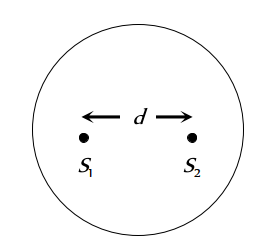
Two coherent sources separated by distance $d$ are radiating in phase having wavelength $\lambda$. A detector moves in a big circle around the two sources in the plane of the two sources. The angular position of $n=4$ interference maxima is given as
Image
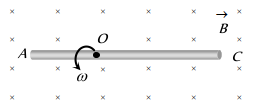
A conducting rod $A C$ of length $4 /$ is rotated about a point $O$ in a uniform magnetic field $\vec{B}$ directed into the paper. $A O=I$ and $O C=3l.$ Then
Image
When an ideal monoatomic gas is heated at constant pressure, fraction of heat energy supplied which increases the internal energy of gas, is