MCQ
The electron cannot exist inside the nucleus because:
  • A
    de$-$Broglie wavelength associated with electron in $\beta -$decay is much less than the size of nucleus
  • de$-$Broglie wavelength associated with electron in $\beta -$decay is much greater than the size of nucleus
  • C
    de$-$Broglie wavelength associated with electron in $\beta-$ decay is equal to the size of nucleus
  • D
    de$-$Broglie negative charge cannot exist in the nucleus
Answer

Correct option: B.
de$-$Broglie wavelength associated with electron in $\beta -$decay is much greater than the size of nucleus

$\beta−$decay:
$\beta−$ radioactivity occurs when a nucleus emits a negative electron from an unstable radioactive nucleus whose deBroglie wavelength of order $\text{MeV}$ is much larger than nuclear dimensions.

Need a full question paper?

Generate a complete, print-ready paper with questions like this in minutes — across 16+ boards, with answer keys.

Start Generating Free

Similar questions

A screen is placed a distance 40cm away from an illuminated object. A converging lens is placed between the source and the screen and it is attempted to form the image of the source on the screen. If no position could be found, the focal length of the lens:
The reciprocal of resistance is
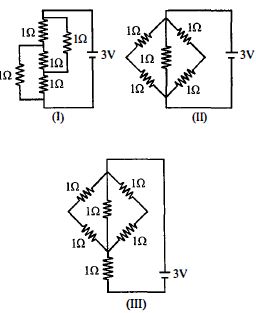
The figure shows three circuits $I, II$ and $III$ which are connected to a $3\,V$ battery. If the powers dissipated by the configurations $I, II$ and $III$ are $P_1 , P_2$ and $P_3$ respectively, then
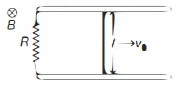
A conducting rod of mass $m$ and length $l$ is free to move without friction on two parallel long conducting rails, as shown below. There is a resistance $R$ across the rails. In the entire space around, there is a uniform magnetic field $B$ normal to the plane of the rod and rails. The rod is given an impulsive velocity $v_0$ Finally, the initial energy $\frac{1}{2} m v_0^2$
A wire loop is rotated in a magnetic field. The frequency of change of direction of the induced $e.m.f.$ is
An electron is moving along positive $x$-axis.Auniform electric field exists towards negative $y$-axis. What should be the direction of magnetic field of suitable magnitude so that net force of electron is zero
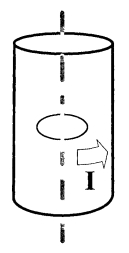
A long circular tube of length $10 \ m$ and radius $0.3 \ m$ carries a current $I$ along its curved surface as shown. A wire-loop of resistance $0.005$ ohm and of radius $0.1 \ m$ is placed inside the tube with its axis coinciding with the axis of the tube. The current varies as $I=I_0 \cos (300 t)$ where $I_0$ is constant. If the magnetic moment of the loop is $N \mu_0 I_0 \sin (300 t)$, then ' $N$ ' is
Before using the tangent galvanometer, its coil is set in
In order to increase the capacity of a parallel plate condenser, one should introduce a sheet of between the plates $($assume that the space is completely filled$).$
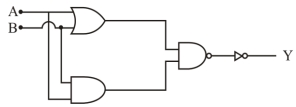
The logic operations performed by the given digital circuit is equivalent to: