MCQ
The electron in a hydrogen atom makes a transition from an excited state to the ground state. Which of the following statements is true
  • A
    Its kinetic energy increases and its potential and total energies decrease
  • B
    Its kinetic energy decreases, potential energy increases and its total energy remains the same
  • lts kinetic and total energies decrease and its potential energy increases
  • D
    Its kinetic, potential and total energies decreases
Answer

Correct option: C.
lts kinetic and total energies decrease and its potential energy increases

Need a full question paper?

Generate a complete, print-ready paper with questions like this in minutes — across 16+ boards, with answer keys.

Start Generating Free

Similar questions

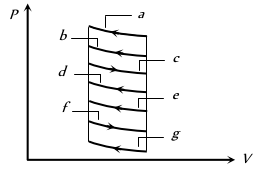
The $P-V$ diagram shows seven curved paths (connected by vertical paths) that can be followed by a gas. Which two of them should be parts of a closed cycle if the net work done by the gas is to be at its maximum value
Image
Diamagnetic substances are
If the length of a cylinder on heating increases by $2 \%$, the area of its base will increase by
Given below are two statements: One is labelled as Assertion $A$ and the other is labelled as Reason $R$.

Assertion $A:$ For measuring the potential difference across a resistance of $600\,\Omega$, the voltmeter with resistance $1000\,\Omega$ will be preferred over voltmeter with resistance $4000\,\Omega$.

Reason $R:$ Voltmeter with higher resistance will draw smaller current than voltmeter with lower resistance.

In the light of the above statements, choose the most appropriate answer from the options given below.

A sample of an ideal gas is taken through a cycle a shown in figure. It absorbs 50 / of energy during the process $A B$, no heat during $B C$, rejects $70 \mathrm{~J}$ during $C A .40 \mathrm{~J}$ of work is done on the gas during $B C$. Internal energy of gas at $A$ is 1500 /, the internal energy at $C$ would be
Image
A cart of mass $M$ is tied by one end of a massless rope of length $ 10 m$. The other end of the rope is in the hands of a man of mass $M$. The entire system is on a smooth horizontal surface. The man is at $x =0$ and the cart at $x=10 m$. If the man pulls the cart by the rope, the man and the cart will meet at the point
Two identical metal balls at temperature $200^{\circ} \mathrm{C}$ and $400^{\circ} \mathrm{C}$ kept in air at $27^{\circ} \mathrm{C}$. The ratio of net heat loss by these bodies is
A thermocouple of resistance $1.6 \Omega$ is connected in series with a galvanometer of $8 \Omega$ resistance. The thermocouple develops and e.m.f. of $10 \mu V$ per degree temperature difference between two junctions. When one junction is kept at $0^{\circ} C$ and the other in a molten metal, the galvanometer reads 8 millivolt. The temperature of molten metal, when e.m.f. varies linearly with temperature difference, will be
If a liquid is heated in weightlessness, the heat is transmitted through
Two resistances $R_1$ arid $\kappa_2$ are made of different materials. The temperature coefficient of the material of $R_1$ is $\alpha$ and of the material of $R_2$ is $-\beta$. The resistance of the series combination of $R_1$ and $R_2$ will not change with temperature, if $R_1 / R_2$ equals