Question

The electron in a hydrogen atom makes a transition , where   and  are the principal quantum numbers of the two states. Assume the Bohr model to be valid. The time period of the electron in the initial state is eight times that in the final state. The possible values of n1 and n2 are

(a)  

(b)  

(c)  

(d)  

Answer

(d)  

Need a full question paper?

Generate a complete, print-ready paper with questions like this in minutes — across 16+ boards, with answer keys.

Start Generating Free

Similar questions

Value of $(\mu_{0}\in_{0})^{-1/2}$ is :

The path executed by a charged particle whose motion is perpendicular to magnetic field i

(a) A straight line

(b) An ellipse

(c) A circle

(d) A helix

A moving charge produces:
  1. Electric field only.
  2. Magnetic field only.
  3. Both of them.
  4. None of them.
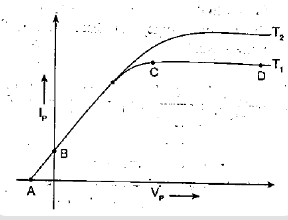
A graph of vacuum diode current Ip​, is plotted against the anode voltage Vp​ for two different temperatures T1​ and T2​ of the cathode, as shown in the figure below. Study the graph and answer the following questions.
For the same anode voltage, (called plate voltage), the current more when the cathode temperature changes from T1​ to T2​ higher temperature.

For the study of the helical structure of nucleic acids, the property of electromagnetic radiation generally used is

(a) Reflection

(b) Interference

(c) Diffraction

(d) Polarization

The magnitude of magnifying power of an astronomical telescope is 5, the focal power of its eyepiece is 10 diopters. The focal power of its objective (in diopters) is:
What will be the focal length of a convex lens whose power is +2.5 D ?
An inductor, a resistor and a capacitor are joined in series with an AC source. As the frequency of the source is slightly increased from a very low value, the reactance.
Which of the following is a mechanical wave?
  1. Radio waves.
  2. X-rays.
  3. Light waves.
  4. Sound waves.
Consider the following statements and select the correct statement(s).
  1. Electric field lines are always perpendicular to equipotential surface.
  2. No two equipotential surfaces can intersect each other.
  3. Electric field lines are in the direction of tangent to an equipotential surface.