MCQ
The electrostatic energy of $Z$ protons uniformly distributed throughout a spherical nucleus of radius $R$ is given by

$E=\frac{3}{5} \frac{Z(Z-1) e^2}{4 \pi \varepsilon_0 R}$

The measured masses of the neutron, ${ }_1^1 \mathrm{H},{ }_7^{15} \mathrm{~N}$ and ${ }_8^{15} \mathrm{O}$ are $1.008665 \mathrm{u}, 1.007825 \mathrm{u}$, $15.000109 \mathrm{u}$ and $15.003065 \mathrm{u}$, respectively. Given that the radii of both the ${ }_7^{15} \mathrm{~N}$ and ${ }_8^{15} \mathrm{O}$ nuclei are same, $1 \mathrm{u}=931.5 \mathrm{MeV} / \mathrm{c}^2$ ( $c$ is the speed of light) and $e^2 /\left(4 \pi \varepsilon_0\right)=1.44 \mathrm{MeV} \mathrm{fm}$. Assuming that the difference between the binding energies of ${ }_7^{15} \mathrm{~N}$ and ${ }_8^{15} \mathrm{O}$ is purely due to the electrostatic energy, the radius of either of the nuclei is

$\left(1 \mathrm{fm}=10^{-15} \mathrm{~m}\right.$ )

  • A
     $2.85 \mathrm{fm}$
  • B
    $3.03 \mathrm{fm}$
  • $3.42 \mathrm{fm}$
  • D
    $3.80 \mathrm{fm}$

Answer

Correct option: C.
$3.42 \mathrm{fm}$
c
$E_0=\frac{3}{5} \times \frac{8 \times 7}{R} \times \frac{e^2}{4 \pi \varepsilon_0}=\frac{3}{5} \times \frac{8 \times 7}{R} \times 1.44 MeV$

$E_N=\frac{3}{5} \times \frac{7 \times 6}{R} \times \frac{e^2}{4 \pi \varepsilon_0}=\frac{3}{5} \times \frac{7 \times 6}{R} \times 1.44 MeV$

$\text { so }\left|E_0-E_N\right|=\frac{3}{5} \times \frac{1.44}{R} \times 7(2)$

Now mass defect of N atom

$8 \times 1.008665+7 \times 1.007825-15.000109$

$=0.1239864 u$

So binding energy $=0.1239864 \times 931.5 MeV$ and mass defect of O atom

$7 \times 1.008665+8 \times 1.007825-15.003065$

$=12019044 u$

So binding energy $=0.12019044 \times 931.5 MeV$

So $\left|B_0-B_N\right|=0.0037960 \times 931.5 MeV$

from $(i)$ and $(ii)$ we get

$R=3.42 fm \text {. }$

Need a full question paper?

Generate a complete, print-ready paper with questions like this in minutes — across 16+ boards, with answer keys.

Start Generating Free

Similar questions

Given the masses of various atomic particles $m _{ p }=1.0072 u , m _{ n }=1.0087 u$ $m _{ e }=0.000548 u , m _{ v }=0, m _{ d }=2.0141 u$ where $p \equiv$ proton, $n \equiv$ neutron, $e \equiv$ electron, $\overline{ v } \equiv$ antineutrino and $d \equiv$ deuteron. Which of the following process is allowed by momentum and energy conservation $?$
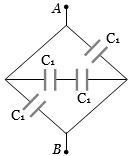
Four identical capacitors are connected as shown in diagram. When a battery of $6 V$ is connected between $A$ and $B$, the charge stored is found to be $1.5\, \mu C$. The value of ${C_1}$ is........$\mu F$
An electron with kinetic energy $K _{1}$ enters between parallel plates of a capacitor at an angle $'\alpha'$ with the plates. It leaves the plates at angle $' \beta '$ with kinetic energy $K _{2}$. Then the ratio of kinetic energies $K _{1}: K _{2}$ will be ....... .
A hydrogen atom (ionisation potential $ 13.6\, eV$) makes a transition from third excited state to first excited state. The energy of the photon emitted in the process is.......$eV$
In a uniform electric field, a cube of side $1\ cm$ is placed. The total energy stored in the cube is $8.85\ \mu J.$ The electric field is parallel to four of the faces of the cube. The electric flux through any one of the remaining two faces is.
Coherent sources are those sources for which
An electric iron draws $5\, amp$, a $TV$ set draws $3\, amp$ and refrigerator draws $2\, amp$ from a $220\, volt$ main line. The three appliances are connected in parallel. If all the three are operating at the same time, the fuse used may be of ............. $amp$
Smallest particle in a chemical element or compound that has the chemical properties of that element or compound is:
The image formed by a concave mirror:
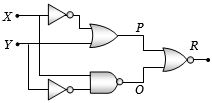
Figure gives a system of logic gates. From the study of truth table it can be found that to produce a high output $(1)$ at $R$, we must have