- ✓$\frac{1}{{4\pi { \in _0}}}\frac{{qQ}}{{d(d + L)}}$
- B$\frac{1}{{4\pi { \in _0}}}\frac{4{qQ}}{{(2d + L)^2}}$
- C$\frac{1}{{4\pi { \in _0}}}\frac{{Qq}}{{d^2}}$
- D$\frac{1}{{4\pi { \in _0}}}\frac{{qQ}}{{{{(d + L)}^2}}}$
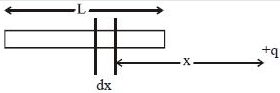
$\Rightarrow \mathrm{F}=\frac{1}{4 \mathrm{n} \in_{0}} \frac{\mathrm{qQ}}{\mathrm{L}}\left|\frac{1}{-\mathrm{x}}\right|_{\mathrm{d}}^{\mathrm{d}+\mathrm{L}}$
$F = \frac{1}{{4\pi { \in _0}}}\frac{{Qq}}{L}\left[ { - \frac{1}{{d + L}} + \frac{1}{d}} \right]$
$ = \frac{1}{{4\pi { \in _0}}}\frac{{qQ}}{L}\left[ {\frac{{ - d + d + L}}{{d(d + L)}}} \right]$
${\rm{F}} = \frac{1}{{4\pi { \in _0}}}\frac{{{\rm{qQ}}}}{{{\rm{d}}({\rm{d}} + {\rm{L}})}}$
Generate a complete, print-ready paper with questions like this in minutes — across 16+ boards, with answer keys.


($A$) Relative change in the radii of two consecutive orbitals does not depend on $Z$
($B$) Relative change in the radii of two consecutive orbitals varies as $1 / n$
($C$) Relative change in the energy of two consecutive orbitals varies as $1 / n^3$
($D$) Relative change in the angular momenta of two consecutive orbitals varies as $1 / n$