MCQ
The $\text{EMF}$ of a cell can be defined as:
  • A
    Work done in taking a unit positive charge once round the circuit.
  • B
    The open circuit voltage of the cell.
  • C
    The terminal voltage when the current is zero.
  • All the above.

Answer

Correct option: D.
All the above.

$\text{EMF}$ of cell can be defined as:
$\rightarrow $ Workdone in taking unit positive charge once round the circuit.
$\rightarrow $ The open circuit voltage of cell.
$\rightarrow $ The terminal voltage when current is zero.

Need a full question paper?

Generate a complete, print-ready paper with questions like this in minutes — across 16+ boards, with answer keys.
Start Generating Free

Similar questions

The camera lens has an aperture of $f$ and the exposure time is $(1/60)\,s$. What will be the new exposure time if the aperture become $1.4\,f$ ?
In a series $LCR$ circuit, operated with an $ac$ of angular frequency $\omega $, the total impedance is
Two straight long conductors AOB and COD are perpendicular to each other and carry currents $i_1$ and $i_2$. The magnitude of the magnetic induction at a point P at a distance a from the point O in a direction perpendicular to the plane ACBD is
An LR circuit with a battery is connected at t = 0. Which of the following quantities is not zero just after the connection?
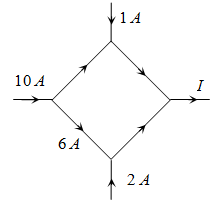
The figure shows a network of currents. The magnitude of currents is shown here. The current I will be
If the dipole with charges $\pm q$ are kept perpendicular to each other inside a closed cube, then the total electric flux emerging out of the cube will be:
Two concave lenses $L_1$ and $L_2$ are kept in contact with each other. If the space between the two lenses is filled with a material of refractive index $\mu\approx1,$ the magnitude of the focal length of the combination:
The work function of a metal is $hv_0$. Light of frequency $v$ falls on this metal. The photoelectric effect will take place only if:
A positively charged thin metal ring of radius R is fixed in the xy - plane with its centre at the O. A negatively charged particle P is released from rest at the point (0, 0, $z_0$), where $z_0>0$. Then the motion of P is


Which of the following statements is false?