MCQ
Which of the following statements is false?
  • A
    Wheatstone bridge is the most sensitive when all the four resistances are of the same order of magnitude
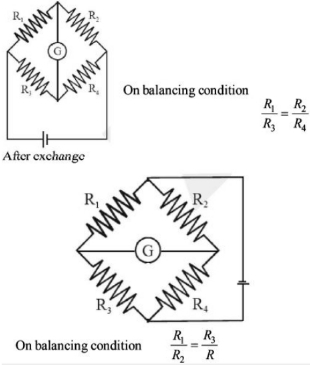
  • In a balanced wheatstone bridge if the cell and the galvanometer are exchanged, the null point is disturbed.
  • C
    A rheostat can be used as a potential divider
  • D
    Kirchhoff's second law represents energy conservation
Answer

Correct option: B.
In a balanced wheatstone bridge if the cell and the galvanometer are exchanged, the null point is disturbed.
b
There is no change in null point, if the cell and the galvanometer are exchanged in a balanced wheatstone birdge.

Need a full question paper?

Generate a complete, print-ready paper with questions like this in minutes — across 16+ boards, with answer keys.

Start Generating Free

Similar questions

An opera glass (Gallilean telescope) measures $9 \,cm$ from the objective to the eyepiece. The focal length of the objective is $15\, cm$. Its magnifying power is
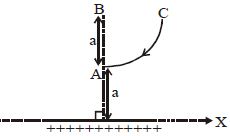
For an infinite line of charge having charge density $\lambda $ lying along $x-$ axis, the work required in moving charge $q$ from $C$ to $A$ along arc $CA$ is :-
In PN-junction diode the reverse saturation current is $10^{-5} amp$ at $27^{\circ} C$ The forward current for a voltage of 0.2 volt is $\left[\exp (7.62)=2038.6, K=1.4 \times 10^{-23} J / K \right]$
When a thin transparent plate of thickness t and refractive index m is placed in the path of one of the two interfering waves of light, then the path difference changes by 
If there had been one eye of the man, then
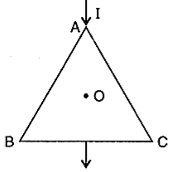
An equilateral triangle is made by uniform wires AB, BC, CA. A current I enteres at A and leaves from the midpoint of BC. If the lengths of each side of the triangle is L, the magnetic field B at the centroid O of the triangle is:
Image
A student says that he had applied a force $\text{F}=-\text{k}\sqrt{\text{x}}$ on a particle and the particle moved in simple harmonic motion. He refuses to tell whether k is a constant or not. Assume that he was worked only with positive x and no other force acted on the particle.
Resistance of the conductor depends upon:
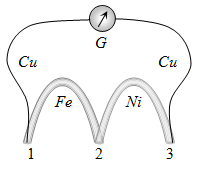
Three wires of copper, iron and nickel are joined to form three junctions as shown in Fig. When the temperature of junction 1 is kept 50℃ with the other two junctions at 0℃, the sensitive galvanometer gives a deflection of 14 divisions. When the temperature of junction 3 is kept 50℃, with the other two junctions at 0℃, the galvanometer gives a deflection of 11 divisions. Then the deflection given by the galvanometer, when temperature of the junction 2 is kept at 50℃, with the other two junctions at 0℃, will be

Identify the type of materials which develop electric currents in them, when an electric field is applied.