The ends of a stretched wire of length $L$ are fixed at $x = 0$ and $x = L.$ In one experiment, the displacement of the wire is ${y_1} = A\sin (\pi x/L)\sin \omega t$ and energy is ${E_1}$, and in another experiment its displacement is ${y_2} = A\sin (2\pi x/L)\sin 2\omega t$ and energy is ${E_2}$. Then
IIT 2001, Medium


Download our appand get started for free
Experience the future of education. Simply download our apps or reach out to us for more information. Let's shape the future of learning together!No signup needed.*
Similar Questions
- 1$Assertion :$ Two waves moving in a uniform string having uniform tension cannot have different velocities.View Solution
$Reason :$ Elastic and inertial properties of string are same for all waves in same string. Moreover speed of wave in a string depends on its elastic and inertial properties only. - 2A wave represented by the given equation $Y = A\sin \left( {10\,\pi \,x + 15\,\pi \,t + \frac{\pi }{3}} \right)$, where $x$ is in meter and $t$ is in second. The expression representsView Solution
- 3The equation of a travelling wave is $y = 60\cos (1800t - 6x)$ where $y$ is in microns, $t$ in seconds and $x$ in metres. The ratio of maximum particle velocity to velocity of wave propagation isView Solution
- 4An open pipe of length $l$ vibrates in fundamental mode. The pressure variation is maximum atView Solution
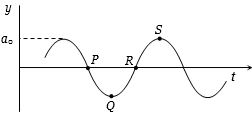
- 5A wave motion has the function $y = {a_0}\sin (\omega \,t - kx)$. The graph in figure shows how the displacement $y$ at a fixed point varies with time $t$. Which one of the labelled points shows a displacement equal to that at the position $x = \frac{\pi }{{2k}}$ at time $t = 0$View Solution
- 6View SolutionWhich of the following equations represents a travelling wave ?
- 7An open pipe of length $33\, cm$ resonates to a frequency of $1000\,Hz$. The mode of vibration is: (velocity of sound $= 330\, m/s$)View Solution
- 8A $1 cm$ long string vibrates with fundamental frequency of $256\, Hz$. If the length is reduced to $\frac{1}{4}cm$ keeping the tension unaltered, the new fundamental frequency will beView Solution
- 9View SolutionWhen a wave travelling in medium is reflected from the boundary of a denser medium, which of the following will not change?
- 10A closed organ pipe of radius $r_1$ and an open organ pipe of radius $r_2$ and having same length $'L'$ resonate when excited with a given tunning fork. Closed organ pipe resonates in its fundamental mode where as open organ pipe resonates in its first overtone, thenView Solution