MCQ
The energy contained in a small volume through which an electromagnetic wave is passing oscillates with:
- AZero frequency.
- BThe frequency of the wave.
- CHalf the frequency of the wave.
- DDouble the frequency of the wave.
Explanation:
The energy per unit volume of an electromagnetic wave,
$\text{u}=\frac{1}{2}\in_0\text{E}^2+\frac{\text{B}^2}{2\mu_0}$
The energy of the given volume can be calculated by multiplying the volume with the above expression.
$\text{U}=\text{u}\times\text{V}=\Big(\frac{1}{2}\in_0\text{E}^2+\frac{\text{B}^2}{2\mu_0}\Big)\times\text{V}\ ....(\text{i})$
Let the direction of propagation of the electromagnetic wave be along the z-axls. Then, the electric and magnetic fields at a particular point are given by,
$\text{E}_\text{x}=\text{E}_0\sin(\text{kz}-\omega\text{t})$
$\text{B}_\text{y}=\text{B}_0\sin(\text{kz}-\omega\text{t})$
Substituting the values of electric and magnetic fields in (1) we get,
$\text{U}=\Big(\frac{1}{2}\in_0\big(\text{E}_0^2\sin^2(\text{kz}-\omega\text{t})+\frac{\text{B}^2_0\sin^2(\text{kz}-\omega\text{t})}{2\mu_0}\Big)\times\text{V}$
$\text{U}=\Big(\in_0\text{E}^2_0\frac{(1-\cos(2\text{kz}-2\omega\text{t}))}{4}+\frac{\text{B}_0^2(1-\cos(2\text{kz}-2\omega\text{t}))}{4\mu_0}\Big)\times\text{V}$
From the above expression, it can be easily understood that the energy of the electric and magnetic fields have angular frequency $2\omega$ Thus. the frequency of the energy of the electromagnetic wave will also be double.
Generate a complete, print-ready paper with questions like this in minutes — across 16+ boards, with answer keys.
Assertion : Two P-N junction diodes placed back to back, will work as a NPN transistor.
Reason : The P-region of two PN junction diodes back to back will form the base of NPN transistor.
|
(a) If both assertion and reason are true and the reason is the correct explanation of the assertion. |
|
(b) If both assertion and reason are true but reason is not the correct explanation of the assertion. |
|
(c) If assertion is true but reason is false. |
|
(d) If the assertion and reason both are false. |
Two capacitors of 1mF and 2mF are connected in series, the resultant capacitance will be
|
(a) 4μF |
(b) |
(c) |
(d) 3 μF |
An alternating voltage of 141.4V (rms) is applied to a vacuum diode as shown in the figure. The maximum potential difference across the condenser will be
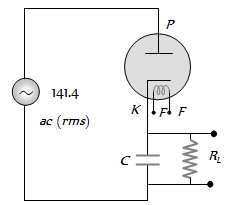
|
(a) 100 V |
(b) 200 V |
(c) 100 |
(d) 200 |
$>\text{v}$
$<\text{v}$
$=\frac{1}{\text{v}}$
$=\text{v}$
An N-type and P-type silicon can be obtained by doping pure silicon with
|
(a) Arsenic and Phosphorous |
(b) Indium and Aluminium |
|
(c) Phosphorous and Indium |
(d) Aluminium and Boron |


