The energy emitted per second by a black body at $27^o\ C$ is $10\ J$. If the temperature of the black body is increased to $327^o\ C$ , the energy emitted per second will be ......... $J$
Medium


Download our appand get started for free
Experience the future of education. Simply download our apps or reach out to us for more information. Let's shape the future of learning together!No signup needed.*
Similar Questions
- 1A black body at a temperature of ${227^o}C$ radiates heat energy at the rate of $5 cal/cm^2-sec$. At a temperature of ${727^o}C$, the rate of heat radiated per unit area in $cal/cm^2$ will beView Solution
- 2Which of the following circular rods. (given radius $ r$ and length $l$ ) each made of the same material as whose ends are maintained at the same temperature will conduct most heatView Solution
- 3There is formation of layer of snow $x\,cm$ thick on water, when the temperature of air is $ - {\theta ^o}C$ (less than freezing point). The thickness of layer increases from $x$ to $y$ in the time $t$, then the value of $t$is given byView Solution
- 4View SolutionCooling law is based upon
- 5View SolutionA hot body will radiate heat most rapidly if its surface is
- 6The maximum energy in the thermal radiation from a hot source occurs at a wavelength of $11 \times {10^{ - 5}}cm$. According to Wein's law, the temperature of the source (on Kelvin scale) will be $n$ times the temperature of another source (on Kelvin scale) for which the wavelength at maximum energy is $5.5 \times {10^{ - 5}}cm$. The value $n$ isView Solution
- 7A hot body, obeying Newton's law of cooling is cooling down from its peak value $80\,^oC$ to an ambient temperature of $30\,^oC$ . It takes $5\, minutes$ in cooling down from $80\,^oC$ to $40\,^oC$. ........ $\min.$ will it take to cool down from $62\,^oC$ to $32\,^oC$ ? (Given $ln\, 2\, = 0.693, ln\, 5\, = 1.609$)View Solution
- 8Two identical metal balls at temperature ${200^o}C$and ${400^o}C$ kept in air at ${27^o}C$. The ratio of net heat loss by these bodies isView Solution
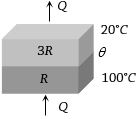
- 9In the following figure, two insulating sheets with thermal resistances $R$ and $3R$ as shown in figure. The temperature $\theta$ is ...... $^oC$View Solution
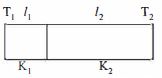
- 10One end of a thermally insulated rod is kept at a temperature $T_1$ and the other at $T_2$ . The rod is composed of two sections of length $l_1$ and $l_2$ and thermal conductivities $K_1$ and $K_2$ respectively. The temperature at the interface of the two section isView Solution