There is formation of layer of snow $x\,cm$ thick on water, when the temperature of air is $ - {\theta ^o}C$ (less than freezing point). The thickness of layer increases from $x$ to $y$ in the time $t$, then the value of $t$is given by
Medium


Download our appand get started for free
Experience the future of education. Simply download our apps or reach out to us for more information. Let's shape the future of learning together!No signup needed.*
Similar Questions
- 1The energy spectrum of a black body exhibits a maximum around a wavelength ${\lambda _o}.$ The temperature of the black body is now changed such that the energy is maximum around a wavelength $\frac{{3{\lambda _o}}}{4}$.The power radiated by the black body will now increase by a factor ofView Solution
- 2If between wavelength $\lambda $and $\lambda + d\lambda $, ${e_\lambda }$and ${a_\lambda }$ be the emissive and absorptive powers of a body and ${E_\lambda }$ be the emissive power of a perfectly black body, then according to Kirchoff's law, which is trueView Solution
- 3There is a rough black spot on a polished metallic plate. It is heated upto $1400 K$ approximately and then at once taken in a dark room. Which of the following statements is trueView Solution
- 4A calorimeter of mass $0.2$ kg and specific heat $900 J/kg-K$ . Containing $0.5$ kg of a liquid of specific heat $2400J /kg-K$ . Its temperature falls from ${60^o}C\,{\rm{to}}\,\,{\rm{5}}{{\rm{5}}^{\rm{o}}}C$ in one minute. The rate of cooling is ....... $J/s$View Solution
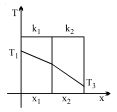
- 5The temperature drop through each layer of a two layer furnace wall is shown in figure. Assume that the external temperature $T_1$ and $T_3$ are maintained constant and $T_1 > T_3$. If the thickness of the layers $x_1$ and $x_2$ are the same, which of the following statements are correct.View Solution
- 6The end $A$ of a rod $AB$ of length $1\,m$ is maintained at $80\,^oC$ and the end $B$ at $0\,^oC.$ The temperature at a distance of $60\,\,c.m.$ from the end $A$ is......... $^oC$View Solution
- 7The intensity of radiation emitted by the sun has its maximum value at a wavelength of $510\;nm$ and that emitted by the north star has the maximum value at $350\;nm$. If these stars behave like black bodies, then the ratio of the surface temperature of the sun and north star isView Solution
- 8$A$ wall is made up of two layers $A$ and $B$ . The thickness of the two layers is the same, but materials are different. The thermal conductivity of $A$ is double than that of $B$ . In thermal equilibrium the temperature difference between the two ends is ${36^o}C$. Then the difference of temperature at the two surfaces of $A$ will be ....... $^oC$View Solution
- 9The two opposite faces of a cubical piece of iron (thermal conductivity $= 0.2\, CGS$ units) are at ${100^o}C$ and ${0^o}C$ in ice. If the area of a surface is $4c{m^2}$, then the mass of ice melted in $10$ minutes will be ...... $gm$View Solution
- 10View SolutionRelation between the colour and the temperature of a star is given by