MCQ
The energy of a $2p $ orbital except hydrogen atom is
  • A
    Less than that of $s{p^2}$ orbital
  • More than that of $2s$ orbital
  • C
    Equal to that of $2s$ orbital
  • D
    Double that of $2s$ orbital

Answer

Correct option: B.
More than that of $2s$ orbital
b
Atomic orbitals are filled always in the increasing order of their energies. $2s$ orbital is filled first than the $2 p$-orbital.

It means that $2 p$-orbital has more energy than the $2s$-orbital.

Need a full question paper?

Generate a complete, print-ready paper with questions like this in minutes — across 16+ boards, with answer keys.

Start Generating Free

Similar questions

The amount of energy released on the addition of an electron in outermost shell of an  atom is called 
The highest possible oxidation states of uranium and plutonium, respectively, are
Simplified absorption spectra of three complexes $((i),$$( ii)$ and $( iii ))$ of $M ^{ n +}$ ion are provided below; their $\lambda_{\max }$ values are marked as $A, B$ and $C$ respectively. The correct match between the complexes and their $\lambda_{\max }$ values is

$(i)$ $\left[ M ( NCS )_{6}\right]^{(-6+ n )}$

$(ii)$ $\left[ MF _{6}\right]^{(-6+ n )}$

$(iii)$ $\left[ M \left( NH _{3}\right)_{6}\right]^{ n ^{+}}$
When chlorine reacts with a gas $X,$ an explosive inorganic compound $Y$ is formed. Then $X$ and $Y$ will be
When $1\ gm$ equivalent of strong acid reacts with strong base heat released is $13.5\ Kcal$ .  when $1\ gm$ equivalent $H_2A$ is completely neutralised against strong base $13\ Kcal$ is released. When $1\ gm$ equivalent $B(OH)_2$ is  completely neutralised against strong acid $10\ Kcal$ heat is released. Calculate enthalpy change when $1\ mole\ H_2A$ is completely neutralised by $B(OH)_2$........$K\,cal$
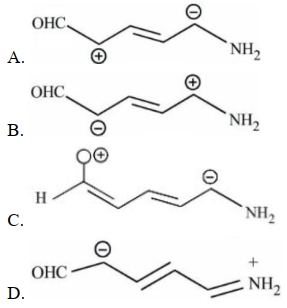
Increasing order of stability of the resonance structure is:
Which of the following oxidation reactions can be carried out with chromic acid in aqueous acetone at $5 - {10\,^o}C$
$NH_4CN$ is a salt of weak acid $HCN (K_a = 6.2 \times 10^{-10})$ and a weak base $NH_4OH (K_b = 1.8 \times 10^{-5})$. A one molar solution of $NH_4CN$ will be:
When $0.15\, \mathrm{~g}$ of an organic compound was analyzed using Carius method for estimation of bromine, $0.2397 \,\mathrm{~g}$ of $AgBr$ was obtained. The percentage of bromine in the organic compound is $.....$ (Nearest integer)

[Atomic mass : Silver $=108$, Bromine $=80]$

The quantum number/s needed to describe an electron fully in an atom is/are: