MCQ
The enthalpy of vapour is $10\ kcal/mole$ higher than liquid at $350\  K$ and $2\ atm$ . Under given conditions, the difference in internal energy of vapour and liquid will be ......$cal.$
  • A
    $10700$
  • B
    $-9300$
  • $9300$
  • D
    $-10700$

Answer

Correct option: C.
$9300$
c
$\mathrm{H}_{2} \mathrm{O}(l) \rightarrow \mathrm{H}_{2} \mathrm{O}(\mathrm{g})$

$\Delta \mathrm{H}=\Delta \mathrm{U}+\Delta \mathrm{ngRT}$

$10000=\rightarrow \mathrm{U}+1 \times 2 \times 350$

$ \Rightarrow $  $\Delta \mathrm{U}=9300 \,\mathrm{cal}$

Need a full question paper?

Generate a complete, print-ready paper with questions like this in minutes — across 16+ boards, with answer keys.

Start Generating Free

Similar questions

Which of the following species contains three bond pairs and one lone pair around the central atom?
Answer the following by appropriately matching the lists based on the information given in the paragraph Consider the Bohr's model of a one-electron atom where the electron moves around the nucleus. In the following $List-I$ contains some quantities for the $n^{t /}$ orbit of the atom and $List-II$ contains options showing how they depend on $n$.

Which of the following options has the correct combination considering $List-I$ and $List-II$?

$List-I$ $List-II$
$(I)$ Radius of the $n^{\text {th }}$ orbit $(P)$ $\propto n ^{-2}$
$(II)$ Angular momentum of the electron in the $n^{\text {th }}$ orbit $(Q)$ $\propto n ^{-1}$
$(III)$ Kinetic energy of the electron in the $n^{\text {th }}$ orbit $(R)$ $\propto n ^0$
$(IV)$ Potential energy of the electron in the $n^{\text {th }}$ orbit $(S)$ $\propto n ^1$
  $(T)$ $\propto n ^2$
  $(U)$ $\propto n ^{1 / 2}$

($1$) Which of the following options has the correct combination considering $List-I$ and $List-II$?

$(1) (II), (R)$ $(2) (I), (P)$ $(3) (I), (T)$ $(4) (II), (Q)$

($2$) Which of the following options has the correct combination considering $List-I$ and $List-II$?

$(1) (III), (S)$ $(2) (IV), (Q)$ $(3) (IV),(U)$ $(4) (III), (P)$

Give the answer or quetion ($1$) and ($2$)
For the gas phase reaction  ${A_2}_{(g)} + {B_2}_{(g)} \rightarrow {2AB}_{(g)}$ taking place at constant pressure and temperature where all gases are behaving ideally which of the following must be correct
$64 \,gm$ of an organic compound contains $24\, gm$ of carbon, $8\,gm$ of hydrogen and the rest oxygen. The empirical formula of the compound is
Assertion : $1-$ Butene on reaction with $HBr$ in the presence of a peroxide produces $1-$ bromobutane.
Reason : It involves the formation of a primary radical.
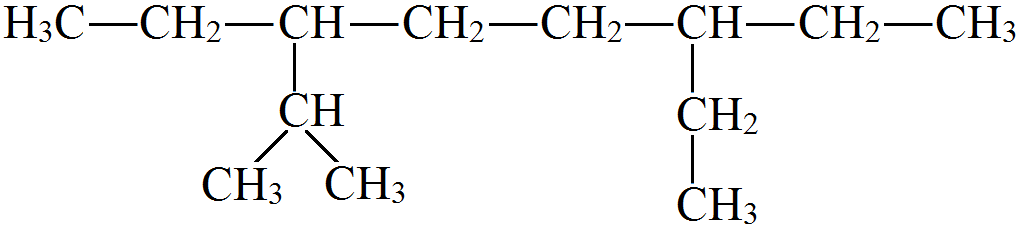
The correct $\text{IUPAC}$ name of the following alkane is :
The structure of $E-(S)-1-$ chloro $-1-$ bromo $-2-$ methyl $- 2-$ hexene is best represented by
For the energy levels in an atom, which one of the following statements is correct
Correct order of electron affinity ?
Which of the following ion is the smallest ion