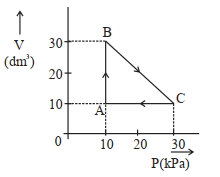
Correct option: C.$3R\,\ln \left( {\frac{{573}}{{473}}} \right)$
c
Solution:- (C) $3 R \ln \left(\frac{573}{473}\right)$
As we know that, $\Delta S = nC _{ V } \ln \frac{ T _{2}}{ T _{1}}+ nR \ln V _{2} V _{1}$
$\because$ The process is isochoric, i.e., volume is constant.
$\therefore \Delta S = nC _{ V } \ln \frac{ T _{2}}{ T _{1}}$
Given:-
$n =2 moles$
$C _{ P }=\frac{3}{2} R [\because$ the gas is monoatomic $]$
$T _{2}=200^{\circ} C =(200+273) K =473 K$
$T _{1}=300^{\circ} C =(300+273) K =573 K$
$\therefore \Delta S =2 \times \frac{3}{2} R \times \ln \left(\frac{573}{473}\right)$
$\Rightarrow \Delta S =3 R \ln \left(\frac{573}{473}\right)$
Hence the change in entropy of the gas is $3 R \ln \left(\frac{573}{473}\right)$