The equation of a transverse wave is given by $y = 10\sin \pi (0.01x - 2t)$ where $x$ and $y$ are in $cm$ and $t$ is in second. Its frequency is .... ${\sec ^{ - 1}}$
Easy
Download our app for free and get started
(c) Comparing with the standard equation,
$y = A\sin \frac{{2\pi }}{\lambda }(vt - x)$, we have
$v = 200$$cm/\sec $, $\lambda = 200$$cm\,;$$\therefore $$n = \frac{v}{\lambda } = 1$${\sec ^{ - 1}}$

Download our appand get started for free
Experience the future of education. Simply download our apps or reach out to us for more information. Let's shape the future of learning together!No signup needed.*
Similar Questions
- 1A transverse wave is passing through a stretched string with a speed of $20\ m/s.$ The tension in the string is $20\ N$. At a certain point $P$ on the string, it is observed that energy is being transferred at a rate of $40 \ mW$ at a given instant. Find the speed of point $P$.View Solution
- 2Sound waves of frequency $660 \,\,Hz$ fall normally on a perfectly reflecting wall. The shortest distance from the wall at which the air particle has maximum amplitude of vibration is .... $m$ (velocity of sound in air is $330 \,\,m/s$)View Solution
- 3At a moment in a progressive wave, the phase of a particle executing $S.H.M.$ is $\frac{\pi }{3}$. Then the phase of the particle $15 cm$ ahead and at the time $\frac{T}{2}$ will be, if the wavelength is $60 cm$View Solution
- 4A transverse sinusoidal wave of amplitude $a,$ wavelength $\lambda$ and frequency $n$ is travelling on a stretched string. The maximum speed of any point on the string is $v/10,$ where $v$ is the speed of propagation of the wave. If $a = {10^{ - 3}}\,m$ and $v = 10\,m{s^{ - 1}}$, then $\lambda$ and $n$ are given byView Solution
- 5View SolutionIf the temperature increases, then what happens to the frequency of the sound produced by the organ pipe
- 6The displacement at a point due to two waves are $y_1=4 \sin (500 \pi t)$ and $y_2=2 \sin (506 \pi t)$. The result due to their superposition will beView Solution
- 7A source of sound of frequency $90$ vibrations/ sec is approaching a stationary observer with a speed equal to $1/10$ the speed of sound. What will be the frequency heard by the observer .... $vibrations/sec$View Solution
- 8Two tuning forks have frequencies $450\, Hz$ and $454\, Hz$ respectively. On sounding these forks together, the time interval between successive maximum intensities will be .... $sec$View Solution
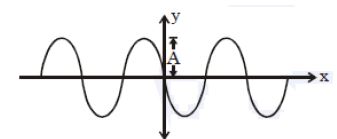
- 9A progressive wave travelling along the positive $x-$ direction is represented by $y(x, t) = A\,sin\,\left( {kx - \omega t + \phi } \right)$. Its snapshot at $t = 0$ is given in the figure For this wave, the phase $\phi $ isView Solution
- 10A source and listener are both moving towards each other with speed $v/10$, where $v$ is the speed of sound. If the frequency of the note emitted by the source is $f$, the frequency heard by the listener would be nearlyView Solution