If the temperature increases, then what happens to the frequency of the sound produced by the organ pipe
Easy


Download our appand get started for free
Experience the future of education. Simply download our apps or reach out to us for more information. Let's shape the future of learning together!No signup needed.*
Similar Questions
- 1View SolutionSound travels in rocks in the form of
- 2View SolutionIt is possible to distinguish between the transverse and longitudinal waves by studying the property of
- 3A wave is represented by the equation $y = 0.5\sin (10t - x)m$. It is a travelling wave propagating along the $+ x$ direction with velocity .... $m/s$View Solution
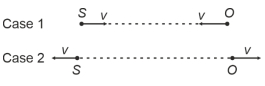
- 4A source $(S)$ of sound has frequency $240 \ Hz$. When the observer $(O)$ and the source move towards each other at a speed $v$ with respect to the ground (as shown in Case $1$ in the figure), the observer measures the frequency of the sound to be $288 \ Hz$. However, when the observer and the source move away from each other at the same speed $v$ with respect to the ground (as shown in Case $2$ in the figure), the observer measures the frequency of sound to be $n Hz$. The value of $n$ is. . . . . .View Solution
- 5When a car is approaching the observer, the frequency of horn is $100 Hz$. After passing the observer, it is $50\,Hz$. If the observer moves with the car, the frequency will be $\frac{ x }{3} Hz$ where $x =.....$View Solution
- 6A siren placed at a railway platform is emitting sound of frequency $5 kHz$. A passenger sitting in a moving train $A$ records a frequency of $5.5 kHz$ while the train approaches the siren. During his return journey in a different train $B$ he records a frequency of $6.0 kHz$ while approaching the same siren. The ratio of the velocity of train $B$ to that of train $A$ isView Solution
- 7The frequency of a car horn encountered a change from $400\, {Hz}$ to $500\, {Hz}$, when the car approaches a vertical wall. If the speed of sound is $330\, {m} / {s}$. Then the speed of car is $.....\,{km} / {h} .$View Solution
- 8Two travelling waves of equal amplitudes and equal frequencies move in opposite directions along a string. They interfere to produce a stationary wave whose equation is given by $y=\left(10 \cos \pi x \sin \frac{2 \pi t}{T}\right)\, cm$View Solution
The amplitude of the particle at $x =\frac{4}{3} \,cm$ will be........ $cm$.
- 9A source of sound is travelling with a velocity $40\, km/hour$ towards observer and emits sound of frequency $2000 Hz$. If velocity of sound is $1220 \,km/hour$, then what is the apparent frequency heard by an observer .... $Hz$View Solution
- 10A uniform narrow $1.95\,\, m$ long pipe is open at both ends. It resonates at two successive harmonic of frequency $275\,\, Hz$ and $330 \,Hz.$The speed of sound in the tube is ...... $m/s$View Solution