Question
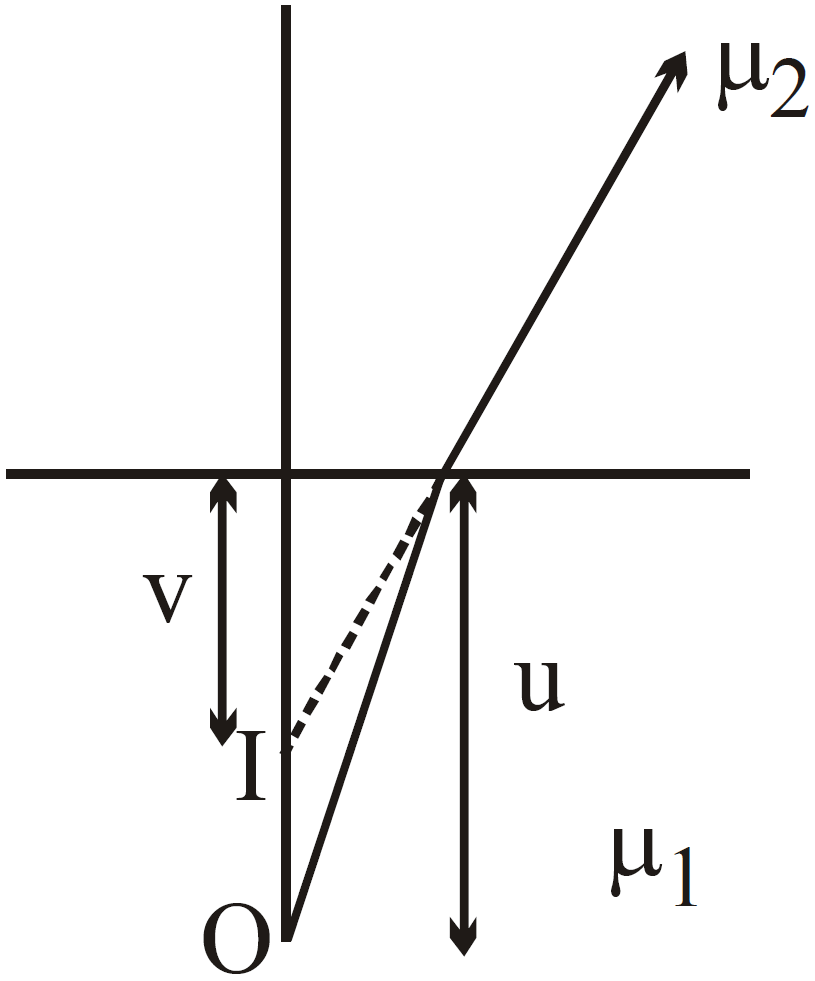
The equation of refraction at a spherical surface is $\frac{\mu_2}{\text{v}}-\frac{\mu_1}{\text{u}}-=\frac{\mu_2-\mu_1}{\text{R}}.$ Taking $\text{R}=\infty,$ show that this equation leads to the equation $\frac{\text{Real depth}}{\text{Apparent depth}}=\frac{\mu_2}{\mu_1}$ for refraction at a plane surface.

Answer

$\frac{\mu_2}{\text{v}}-\frac{\mu_1}{\text{u}}-=\frac{\mu_2-\mu_1}{\infty}$$\frac{\mu_2}{\text{v}}=\frac{\mu_1}{\text{u}}$
$\Rightarrow\frac{\mu_2}{\mu_1}=\frac{\text{v}}{\text{u}}.$

Need a full question paper?

Generate a complete, print-ready paper with questions like this in minutes — across 16+ boards, with answer keys.

Start Generating Free

Similar questions

Figure. shows a cylindrical tube of cross-sectional area A fitted with two frictionless pistons. The pistons are connected to each other by a metallic wire. Initially, the temperature of the gas is $T_0$ and its pressure is P, which equals the atmospheric pressure. (a) What is the tension in the wire? (b) What will be the tension if the temperature is increased to $2T_0$?
In Exercise, let us take the position of mass when the spring is unstreched as x = 0, and the direction from left to right as the positive direction of x-axis. Give x as a function of time t for the oscillating mass if at the moment we start the stopwatch (t = 0), the mass is:At the maximum compressed position.
In what way do these functions for SHM differ from each other, in frequency, in amplitude or the initial phase?
Why does a gas not have a unique value of specific heat?
Elasticity is said to be internal property of matter. Explain.
Answer the following questions:Time period of a particle in SHM depends on the force constant k and mass m of the particle: $\text{T}=2\pi\sqrt{\frac{\text{m}}{\text{k}}}.$ A simple pendulum executes SHM approximately. Why then is the time period of a pendulum independent of the mass of the pendulum?
At a pressure of $10^5 N / m ^2$ the volume of one cubic meter of gas expands and doubles. Find the value of work done: (i) at constant pressure (ii) constant temperature.
The length and breadth of a rectangle are measured as $(\text{a}\pm\Delta\text{a})$ and $(\text{b}\pm\Delta\text{b})$ respectively. Find:
  1. Relative error.
  2. Absolute error in the measurement of area.
Can a body in translatory motion have angular momentum? Explain.
Water flows through a horizontal pipe of radius 1cm at a speed of $2\text{ms}^{-1}$, what should be the diameter of its nozzle if the water is to come out at a speed of 10ms?
Is physics more of a philosophy or more of a mathematical science?