The equation of $SHM$ is given as:
$x = 3\,sin\, 20\pi t + 4\, cos\, 20\pi t$ ,
where $x$ is in $cms$ and $t$ is in $seconds$ . The amplitude is ..... $cm$
Easy
Download our app for free and get started
The amplitude of oscillation $=5 \mathrm{cm}$
Explanation:
We are given that
Displacement of a particle in S.H.M $\mathrm{x}(\mathrm{t})=3 \sin (20 \pi t)+4 \cos (20 \pi t)$
We have to find the amplitude of simple harmonic motion.
We know that general equation of displacement in SHM is given by $x(t)=c_{1} \cos (\omega t)+c_{1} \sin (\omega t)$
Then, amplitude $=A=\sqrt{c_{1}^{2}+c_{2}^{2}}$
By comparing with the given equation
Then, we get
$c_{1}=4, c_{2}=3$
Amplitude $=\sqrt{(3)^{2}+(4)^{2}}$
Amplitude $=\sqrt{25}=5$
It is always positive because it is maximum displacement from equilibrium position.
Hence, the amplitude of oscillation=5 $\mathrm{cm}$

Download our appand get started for free
Experience the future of education. Simply download our apps or reach out to us for more information. Let's shape the future of learning together!No signup needed.*
Similar Questions
- 1A vertical mass spring system executes simple harmonic oscillations with a period of $2\,s$. A quantity of this system which exhibits simple harmonic variation with a period of $1\, sec$ isView Solution
- 2Displacement-time equation of a particle executing $SHM$ is $x\, = \,A\,\sin \,\left( {\omega t\, + \,\frac{\pi }{6}} \right)$ Time taken by the particle to go directly from $x\, = \, - \frac{A}{2}$ to $x\, = \, + \frac{A}{2}$ isView Solution
- 3A particle is executing $SHM$ with amplitude $A,$ time period $T,$ maximum acceleration $a_o$ and maximum velocity $v_0.$ Its starts from mean position at $t=0$ and at time $t,$ it has the displacement $A/2,$ acceleration $a$ and velocity $v$ thenView Solution
- 4View SolutionTo make the frequency double of a spring oscillator, we have to
- 5A linear harmonic oscillator of force constant $2 \times 10^6\,Nm^{-1}$ and amplitude $0.01\, m$ has a total mechanical energy of $160\, J.$ ItsView Solution
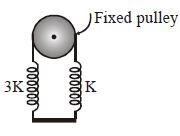
- 6A bar of mass $m$ is suspended horizontally on two vertical springs of spring constant $k$ and $3k$ . The bar bounces up and down while remaining horizontal. Find the time period of oscillation of the bar (Neglect mass of springs and friction everywhere).View Solution
- 7A particle of mass $10\, gm$ is describing $S.H.M.$ along a straight line with period of $2\, sec$ and amplitude of $10, cm$. Its kinetic energy when it is at $5 \,cm$ from its equilibrium position isView Solution
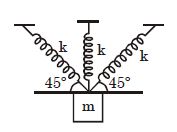
- 8Initially system is in equilibrium. Time period of $SHM$ of block in vertical direction isView Solution
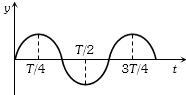
- 9View SolutionThe graph shows the variation of displacement of a particle executing S.H.M. with time. We infer from this graph that
- 10At a given point of time the value of displacement of a simple harmonic oscillator is given as $y = A \cos \left(30^{\circ}\right)$. If amplitude is $40\,cm$ and kinetic energy at that time is $200\, J$, the value of force constant is $1.0 \times 10^{ x }\,Nm ^{-1}$. The value of $x$ is ......View Solution