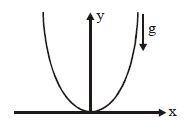
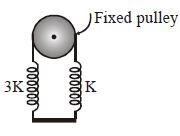
A bar of mass $m$ is suspended horizontally on two vertical springs of spring constant $k$ and $3k$ . The bar bounces up and down while remaining horizontal. Find the time period of oscillation of the bar (Neglect mass of springs and friction everywhere).
Diffcult
Download our app for free and get started
Let the elongation in spring are $\mathrm{x}_{1} \& \mathrm{x}_{2}$
$x_{1}+x_{2}=2 x$
$3 \mathrm{kx}_{1}=\mathrm{kx}_{2}$
$3 \mathrm{kx}_{1}+\mathrm{kx}_{2}=\mathrm{k}_{\mathrm{eq}} \mathrm{x}$
$\mathrm{T}=2 \pi \sqrt{\frac{\mathrm{m}}{\mathrm{k}_{\mathrm{eq}}}}$

Download our appand get started for free
Experience the future of education. Simply download our apps or reach out to us for more information. Let's shape the future of learning together!No signup needed.*
Similar Questions
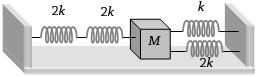
- 1Four massless springs whose force constants are $2k, 2k, k$ and $2k$ respectively are attached to a mass $M$ kept on a frictionless plane (as shown in figure). If the mass $M$ is displaced in the horizontal direction, then the frequency of oscillation of the system isView Solution
- 2A particle executes simple harmonic motion. Its amplitude is $8 \,cm$ and time period is $6 \,s$. The time it will take to travel from its position of maximum displacement to the point corresponding to half of its amplitude, is ............. $s$View Solution
- 3A particle executes $SHM$ of period $1.2\, sec$ and amplitude $8\, cm.$ Find the time it takes to travel $3\,cm$ from the positive extremity of its oscillation. ..... $\sec$View Solution
- 4Out of the following functions representing motion of a particle which represents $SHM$View Solution
$(A)\;y= sin\omega t-cos\omega t$
$(B)\;y=sin^3\omega t$
$(C)\;y=5cos\left( {\frac{{3\pi }}{4} - 3\omega t} \right)$
$(D)\;y=1+\omega t+{\omega ^2}{t^2}$
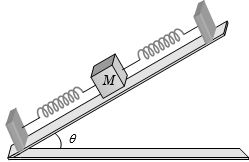
- 5On a smooth inclined plane, a body of mass $M$ is attached between two springs. The other ends of the springs are fixed to firm supports. If each spring has force constant $K$, the period of oscillation of the body (assuming the springs as massless) isView Solution
- 6Two particles execute $SHM$ of same amplitude of $20\, cm$ with same period along the same line about the same equilibrium position. The maximum distance between the two is $20\, cm.$ Their phase difference in radians isView Solution
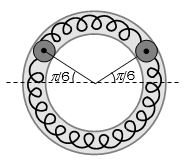
- 7Two identical balls A and B each of mass 0.1 kg are attached to two identical massless springs. The spring mass system is constrained to move inside a rigid smooth pipe bent in the form of a circle as shown in the figure. The pipe is fixed in a horizontal plane. The centres of the balls can move in a circle of radius 0.06 m. Each spring has a natural length of 0.06$\pi$ m and force constant 0.1N/m. Initially both the balls are displaced by an angle $\theta = \pi /6$ radian with respect to the diameter $PQ$ of the circle and released from rest. The frequency of oscillation of the ball B isView Solution
- 8Two springs of force constants $300\, N / m$ (Spring $A$) and $400$ $N / m$ (Spring $B$ ) are joined together in series. The combination is compressed by $8.75\, cm .$ The ratio of energy stored in $A$ and $B$ is $\frac{E_{A}}{E_{B}} .$ Then $\frac{E_{A}}{E_{B}}$ is equal toView Solution
- 9A solid cylinder of density $\rho_0$, cross-section area $A$ and length $l$ floats in a liquid $\rho(> \rho_0)$ with its axis vertical, as shown. If it is slightly displaced downward and released, the time period will beView Solution

- 10A particle of mass $5 × 10^{-5}\ kg$ is placed at lowest point of smooth parabola $x^2 = 40y$ ( $x$ and $y$ in $m$ ). If it is displaced slightly such that it is constrained to move along parabola, angular frequency of oscillation (in $rad/s$) will be approximately:-View Solution