MCQ
The equivalent conductance at infinite dilution $\left( {{ \wedge ^0}} \right)$ for electrolytes $BA$ and $CA$ are $140$ and $120\  S\  cm^2 eq^{-1}$. The equivalent conductance at infinite dilution for $BX$ is $198\  S \ cm^2 eq^{-1}$. The ${ \wedge ^0}$ (in $S\  cm^2 eq^{-1}$) of $CX$ is
  • $178$
  • B
    $198$
  • C
    $218$
  • D
    $130$

Answer

Correct option: A.
$178$
a
$\wedge_{\mathrm{CX}}^{o}=\wedge_{\mathrm{CA}}^{o}+\wedge_{\mathrm{BX}}^{o}-\wedge_{\mathrm{BA}}^{o}$

$=120+198-140$

$=178\, \mathrm{S}\, \mathrm{cm}^{2} \mathrm{eq}^{-1}$

Need a full question paper?

Generate a complete, print-ready paper with questions like this in minutes — across 16+ boards, with answer keys.

Start Generating Free

Similar questions

A salt solution is treated with chloroform drops. Then it is shaked with chlorine water. Chloroform layer becomes violet. Solution contains
$Ph-N{{H}_{2}}+P{{h}_{3}}COH\xrightarrow{{{H}^{+}}/D}\underset{(major)}{\mathop{P}}\,$ (not a $N-$ derivative), Product $(P)$ is
Insulin production and its action in human body are responsible for the level of diabetes. This compound belongs to which of the following categories
At room temperature ${H_2}O$ is a liquid while ${H_2}S$ is a gas. The reason is
For the reaction given below:

$CoCl _{3} . xNH _{3}+ AgNO _{3}( aq ) \rightarrow$

If two equivalents of $AgCl$ precipitate out, then the value of $x$ will be $....$

Chloromethane on treatment with excess of ammonia yields mainly
Arrange these esters in decreasing order of case of esterfication with $C{H_3}OH/{H^ \oplus }$ :

$(I)$ $\begin{array}{*{20}{c}}
  {C{H_3} - CH - COOH} \\ 
  {|\,\,\,\,\,\,\,\,\,\,\,\,\,\,} \\ 
  {C{H_3}\,\,\,\,\,\,\,} 
\end{array}$

$(II)$  $\begin{array}{*{20}{c}}
  {C{H_3} - CH - C{H_2} - COOH} \\ 
  {|\,\,\,\,\,\,\,\,\,\,\,\,\,\,\,\,\,\,\,\,\,\,\,\,\,\,\,\,\,\,} \\ 
  {C{H_3}\,\,\,\,\,\,\,\,\,\,\,\,\,\,\,\,\,\,\,\,\,\,} 
\end{array}$

$(III)$ $\begin{array}{*{20}{c}}
  \,\,{C{H_3}} \\ 
  {|\,\,\,\,\,\,\,\,} \\ 
  {C{H_3} - C - COOH} \\ 
  {|\,\,\,\,\,\,} \\ 
  \,\,{C{H_3}\,} 
\end{array}$

$(IV)$ $(CH_3-CH_2)_3C-COOH$

The standard reduction potential for $L{i^ + }/Li\,;\,\,Z{n^{2 + }}/Zn\,;$ ${H^ + }/{H_2}$ and $A{g^ + }/Ag$ is $ - 3.05,\,\, - 0.762,\,\,0.00$ and $ + 0.80\,\,V.$ Which of the following has highest reducing capacity
Match the column :-

 $\begin{array}{|l|l|l|l|} \hline & Column\,I & & Column\,II \\ & (Reduction\,process) & & (Charge\,required) \\ \hline (a) & 1\,mol\,of\,MnO_4^-\,to\,Mn^{2+} & (p) & 193000\,\,C \\ \hline (b) & 1\,\,mole\,of\,Cr_2O_7^{2-}\,to\,Cr^{3+} & (q) & 289500\,\,C \\ \hline (c) & 1\,\,mole\,of\,Sn^{4+}\,to\,Sn^{2+} & (r) & 482500\,\,C \\ \hline (d) & 1\,mole\,of\,Al^{3+}\,to\,Al & (s) & 579000\,\,C \\ \hline \end{array}$

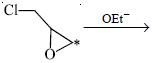
The major product in the given reaction is :