MCQ
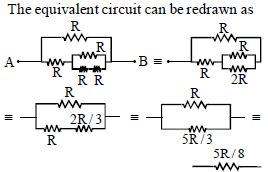
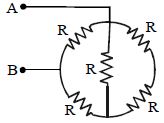
The equivalent resistance between $A$ and $B$ is
  • A
    $\frac {8R}{5}$
  • $\frac {5R}{8}$
  • C
    $\frac {3R}{8}$
  • D
    $\frac {7R}{8}$

Answer

Correct option: B.
$\frac {5R}{8}$
b

Need a full question paper?

Generate a complete, print-ready paper with questions like this in minutes — across 16+ boards, with answer keys.

Start Generating Free

Similar questions

The binding energy of Helium nucleus is $28\ Mev$. What is it's average binding energy per nucleon?
Two wires of resistance $\mathrm{R}_1$ and $\mathrm{R}_2$ have temperature coefficient of resistance $\alpha_1$ and $\alpha_2$, respectively. These are joined in series. The effective temperature coefficient of resistance is
A particle of mass $m$ is moving in a circular orbit under the influence of the central force $F(r)=-k r$, corresponding to the potential energy $V(r)=k r^2 / 2$, where $k$ is a positive force constant and $r$ is the radial distance from the origin. According to the Bohr's quantization rule, the angular momentum of the particle is given by $L=n h$, where $h=h /(2 \pi), h$ is the Planck's constant, and $n$ a positive integer. If $v$ and $E$ are the speed and total energy of the particle, respectively, then which of the following expression($s$) is(are) correct?

$(A)$ $r^2=n h \sqrt{\frac{1}{m k}}$

$(B)$ $v^2=n h \sqrt{\frac{k}{m^3}}$

$(C)$ $\frac{L}{m r^2}=\sqrt{\frac{k}{m}}$

$(D)$ $E=\frac{n h}{2} \sqrt{\frac{k}{m}}$
When a p-n diode is reverse biased, then
Magnetic needle can remain safe in:
A 100 watt bulb working on 200 volt and a 200 watt bulb working on 100 volt have
A parallel beam of fast moving electrons is incident normally on a narrow slit. A screen is placed at a large distance from the slit. If the speed of the electrons is increased, which of the following statement is $CORRECT$ ?
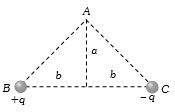
As shown in the figure, charges $ + q$ and $ - q$ are placed at the vertices $B$ and $C$ of an isosceles triangle. The potential at the vertex $A$ is
A photoelectric cell is illuminated by a point source of light $1\; m$ away. When the source is shifted to $2\;m$ then
When an input signal $1$ is applied to a $\text{NOT}$ gate, its output is: