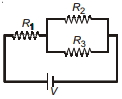
The equivalent resistance between ends $A$ and $B$ is
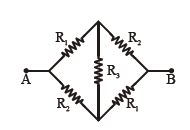
  • AGreater than $\frac{{{R_{1\,}}\, + \,{R_2}}}{2}$
  • BLess than $\frac{{2{R_1}{R_2}}}{{{R_{1\,}}\, + \,{R_2}}}$
  • C Equal to $R_3$ 
  • DDepends on $R_1, R_2$ and $R_3$
Medium
art

Download our app
and get started for free

Experience the future of education. Simply download our apps or reach out to us for more information. Let's shape the future of learning together!No signup needed.*

Similar Questions

  • 1
    ln a balanced wheat stone bridge, current in the galvanometer is zero. It remains zero when:

    $[1]$ battery emf is increased

    $[2]$ all resistances are increased by $10\,ohms$

    $[3]$ all resistances are made five times

    $[4]$ the battery and the galvanometer are interchanged

    View Solution
  • 2
    A steady current $I$ is set up in a wire whose cross-sectional area decreases in the direction of the flow of the current. Then, as we examine the narrowing region,
    View Solution
  • 3
    Calculate the current shown by the ammeter $A$ in the circuit diagram is .............. $A$
    View Solution
  • 4
    How many $60 \,W$ bulbs may be safely run on $220 \,V$ using a $5 \,A$ fuse is .........
    View Solution
  • 5
    Equivalent resistance between the adjacent corners of a regular $n$-sided polygon of uniform wire of resistance $R$ would be:
    View Solution
  • 6
    The equivalent resistance of the following infinite network of resistances is
    View Solution
  • 7
    If you are provided a set of resistances $2\, \Omega, 4\, \Omega$ $6\, \Omega$ and $8\, \Omega$. Connect these resistances so as to obtain an equivalent resistance of $\frac{46}{3}\, \Omega$.
    View Solution
  • 8
    When two identical batteries of internal resistance $1 \Omega$ each are connected in series across a resistor $\mathrm{R}$, the rate of heat produced in $R$ is $J_1$. When the same batteries are connected in parallel across $R$, the rate is $\mathrm{J}_2$. If $\mathrm{J}_1=2.25 \mathrm{~J}_2$ then the value of $\mathrm{R}$ in $\Omega$ is
    View Solution
  • 9
    Resistance of a wire at $0^{\circ} \mathrm{C}, 100^{\circ} \mathrm{C}$ and $t^{\circ} \mathrm{C}$ is found to be $10 \Omega, 10.2 \Omega$ and $10.95 \Omega$ respectively. The temperature $t$ in Kelvin scale is $\qquad$
    View Solution
  • 10
    In the circuit shown here, what is the value of the unknown resistor $R$ so that the total resistance of the circuit between points $P$ and $Q$ is also equal to $R$
    View Solution