MCQ
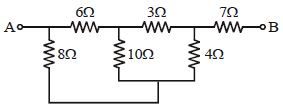
The equivalent resistance between the points $A$ and $B$ is :-
  • A
    $\frac{36}{7}\, \Omega$
  • B
    $10\,  \Omega$
  • $\frac{85}{7}\, \Omega$
  • D
    None of these

Answer

Correct option: C.
$\frac{85}{7}\, \Omega$
c
$R_{A B}=\frac{9 \times 12}{9+12}+7$

$=\frac{85}{7}$

Need a full question paper?

Generate a complete, print-ready paper with questions like this in minutes — across 16+ boards, with answer keys.

Start Generating Free

Similar questions

When a ball is dropped into a lake from a height $4.9 \,m$ above the water level, it hits the water with a velocity $v$ and then sinks to the bottom with the constant velocity $v$. It reaches the bottom of the lake $4.0,s$ after it is dropped. The approximate depth of the lake is ............ $m$
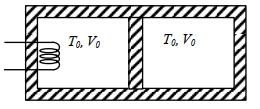
A thermally insulating cylinder has a thermally insulating and frictionless movable partition in the middle, as shown in the figure below. On each side of the partition, there is one mole of an ideal gas, with specific heat at constant volume, $C_v=2 R$. Here, $R$ is the gas constant. Initially, each side has a volume $V_0$ and temperature $T_0$. The left side has an electric heater, which is turned on at very low power to transfer heat $Q$ to the gas on the left side. As a result the partition moves slowly towards the right reducing the right side volume to $V_0 / 2$. Consequently, the gas temperatures on the left and the right sides become $T_L$ and $T_R$, respectively. Ignore the changes in the temperatures of the cylinder, heater and the partition.

($1$) The value of $\frac{T_R}{T_0}$ is

$(A)$ $\sqrt{2}$ $(B)$ $\sqrt{3}$ $(C)$ $2$ $(D)$ $3$

($2$) The value of $\frac{Q}{R T_0}$ is

$(A)$ $4(2 \sqrt{2}+1)$ $(B)$ $4(2 \sqrt{2}-1)$ $(C)$ $(5 \sqrt{2}+1)$ $(D)$ $(5 \sqrt{2}-1)$

Give the answer or qution ($1$) and ($2$)
If the series limit of Lymen series for Hydrogen atom is equal to the series limit of Balmer  series for a hydrogen like atom, then atomic number of this hydrogen like atom will be 
A particle executes simple harmonic motion and is located at $x = a, b$  and  $c$ at times $t_0, 2t_0$ and $3t_0$ respectively. The frequency of the oscillation is
A simple pendulum of length $1\, m$ is oscillating with an angular frequency $10\, rad/s$. The support of the pendulum starts oscillating up and down with a small angular frequency of $1\, rad/s$ and an amplitude of $10^{-2}\, m$. The relative change in the angular frequency of the pendulum is best given by
The electric field intensity at a point in vacuum is equal to
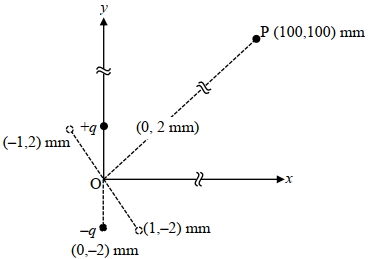
An electric dipole is formed by two charges $+q$ and $-q$ located in xy-plane at $(0,2) \mathrm{mm}$ and $(0,-2) \mathrm{mm}$, respectively, as shown in the figure. The electric potential at point $\mathrm{P}(100,100) \mathrm{mm}$ due to the dipole is $V_0$. The charges $+q$ and $-q$ are then moved to the points $(-1,2) \mathrm{mm}$ and $(1,-2) \mathrm{mm}$, respectively. What is the value of electric potential at $P$ due to the new dipole?
At some point the gravitational potential and also the gravitational field due to earth is zero. The point is
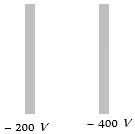
In the following figure two parallel metallic plates are maintained at different potential. If an electron is released midway between the plates, it will move
Nucleus of an atom whose atomic mass is $24$ consists of