MCQ
The example of non-ohmic resistance is:
- ADiode.
- BCopper wire.
- CFilament lamp.
- DCarbon resistor.
Generate a complete, print-ready paper with questions like this in minutes — across 16+ boards, with answer keys.
A potential difference of 42,000 volts is used in an X-ray tube to accelerate electrons. The maximum frequency of the X–radiations produced is (1 eV = 1.6  and h = 6.63
(a) 
|
(b)
|
(c)
|
(d) 
|
A light bulb, a capacitor and a battery are connected together as shown here, with switch S initially open. When the switch S is closed, which one of the following is true

|
(a) The bulb will light up for an instant when the capacitor starts charging |
|
(b) The bulb will light up when the capacitor is fully charged |
|
(c) The bulb will not light up at all |
|
(d) The bulb will light up and go off at regular intervals |
An electron (mass = 9.1  kg; charge = 1.6
  C) experiences no deflection if subjected to an electric field of 3.2
  V/m, and a magnetic fields of 2.0
  Wb/m2. Both the fields are normal to the path of electron and to each other. If the electric field is removed, then the electron will revolve in an orbit of radius
|
(a) 45 m |
(b) 4.5 m |
(c) 0.45 m |
(d) 0.045 m |
The diagram shows-the energy levels for an electron in a certain atom. Which transition shown represents the emission of a photon with the most energy
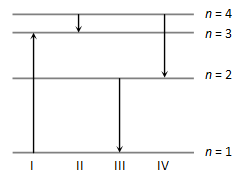
| (a) I | (b) II | (c) III | (d) IV |
When a positive q charge is taken from lower potential to a higher potential point, then its potential energy will
|
(a) Decrease |
(b) Increases |
(c) Remain unchanged |
(d) Become zero |
$\overrightarrow{\text{F}}.\overrightarrow{\text{a}}$
$\overrightarrow{\text{v}}.\overrightarrow{\text{r}}$
$\overrightarrow{\text{a}}.\overrightarrow{\text{r}}$
$\overrightarrow{\text{F}}.\overrightarrow{\text{r}}$