MCQ
The expression $Ze$ gives :
- AThe charge of $\alpha -$ particle
- BThe charge on an atom
- ✓The charge on the nucleus of atomic number $Z$
- DThe kinetic energy of an $\alpha -$ particle
Generate a complete, print-ready paper with questions like this in minutes — across 16+ boards, with answer keys.
$kJ\,mol ^{-1}$ (Nearest integer)
Given : $\Delta_{ dis } H _{ Cl _{2(g)}}^{\circ}=240\,kJ\,mol ^{-1}$.
$\Delta_{ eg } H _{ Cl _{(g)}}^{\circ}=-350\,kJ\,mol ^{-1}$,
$\Delta_{ hyd } H _{ Cl i _{( j )}^{\circ}}^{\circ}=-380\,kJ\,mol ^{-1}$
when attached to $sp^3$ hybridised carbon, their leaving group ability in nucleophilic substitution reaction decrease in the order.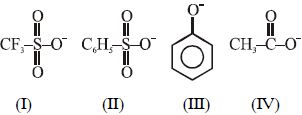
Assertion $(A)$ $:$ When Cu $(II)$ and sulphide ions are mixed, they react together extremely quickly to give a solid.
Reason $(R)$ $:$ The equilibrium constant of $Cu ^{2+}( aq )+ S ^{2-}( aq ) \rightleftharpoons \operatorname{CuS}( s )$ is high because the solubility product is low.