MCQ
The eye can detect  $5 ×10^4$ photons per square metre per sec of green light ($\lambda$ $= 5000\ \mathop A\limits^o $) while the ear can detect ${10^{ - 13}}\,(W/{m^2})$. The factor by which the eye is more sensitive as a power detector than the ear is close to
  • $5$
  • B
    $10$
  • C
    $106$
  • D
    $1539$

Answer

Correct option: A.
$5$
a
(a) $E = \frac{{12375}}{{5000}} = 2.475\,eV\, \approx 4 \times {10^{ - 19}}J$

So the minimum intensity to which the eye can respond

${I_{Eye}} = $ (Photon flux) $×$ (Energy of a photon)

$⇒$ ${I_{Eye}} = (5 \times {10^4}) \times \,(4 \times {10^{ - 19}})\tilde --2 \times {10^{ - 14}}\,(W/{m^2})$

Now as lesser the intensity required by a detector for detection, more sensitive it will be

$\frac{{{S_{Eye}}}}{{{S_{Ear}}}} = \frac{{{I_{Ear}}}}{{{I_{Eye}}}}$$ = \frac{{{{10}^{ - 13}}}}{{2 \times {{10}^{ - 14}}}} = 5$ i.e. as intensity (power) detector, the eye is five times more sensitive than ear.
Need a full question paper?

Generate a complete, print-ready paper with questions like this in minutes — across 16+ boards, with answer keys.

Start Generating Free

Similar questions

In a historical experiment to determine Planck's constant, a metal surface was irradiated with light of different wavelengths. The emitted photoelectron energies were measured by applying a stopping potential. The relevant data for the wavelength $(\lambda)$ of incident light and the corresponding stopping potential $\left(V_0\right)$ are given below :

$\lambda(\mu \mathrm{m})$ $V_0$ (Volt)
$0.3$ $2.0$
$0.4$ $1.0$
$0.5$ $0.4$

Given that $c=3 \times 10^8 \mathrm{~m} \mathrm{~s}^{-1}$ and $e=1.6 \times 10^{-19} \mathrm{C}$, Planck's constant (in units of $\mathrm{J}$ s) found from such an experiment is

The coefficient of restitution $e$ for a perfectly inelastic collision is
Two similar springs $P$ and $Q$ have spring constants $K_P$ and $K_Q$, such that $K_P > K_Q .$ They are stretched first by the same amount $($case $a),$ then by the same force $($case $b).$ The work done by the springs $W_P$ and $W_Q$ are related as, in case $(a)$ and case $(b)$ respectively
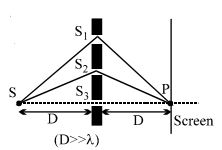
$A$ monochromatic light source of wavelength $\lambda$ is placed at $S$. Three slits $S_1, S_2$ and $S_3$ are equidistant from the source $S$ and the point $P$ on the screen. $S_1P - S_2P = \lambda /6$ and $S_1P - S_3P = 2\lambda /3$. If $I$ be the intensity at $P$ when only one slit is open, the intensity at $P$ when all the three slits are open is
A long straight wire of radius a carries a steady current $i$. The current is uniformly distributed across its cross section. The ratio of the magnetic field at $ a/2$ and $2a$ is
$Assertion :$ For a particle performing $SHM$, its speed decreases as it goes away from the mean position.
$Reason :$ In $SHM$, the acceleration is always opposite to the velocity of the particle.
A mixture of hydrogen and oxygen has volume $2000 \; cm ^{3}$, temperature $300 \; K$, pressure $100 \; kPa$ and mass $0.76 \; g$ The ratio of number of moles of hydrogen to number of moles of oxygen in the mixture will be
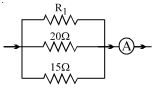
In the given circuit the current flowing through the resisitance $20$ $\mathrm{ohms}$ is $0.3$ $\mathrm{ampere}$ while the ammeter reads $0.8$ $\mathrm{ampere}.$ What is the value of $R_1$? ................ $\mathrm{ohm}$
The electric field in a region is given $\vec E = a\hat i + b\hat j$ . Here $a$ and $b$ are constants. Find the net flux passing through a square area of side $l$ parallel to $y-z$ plane
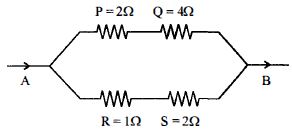
Which of the four resistances $P, Q, R$ and $S$ generate the greatest amount of heat when a current flows from $A$ to $B$ ?