Question
The fig given alongside shows a certain stage in a cell division in a cell with four chromosomes.
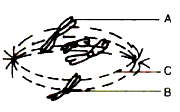
(i) Name the parts of the chromosome labeled A and B.
(ii) Name the structure C. what is its function?
(iii) Name the type of division . Give a reason.
(iv) Name the stage of division.
(v) Name the stages before and after the stage shown in diagram.

Answer

(i) A - Duplicated chromosomes
B - Centromere
(ii) The structure C is Spindle fibre. Its function is to help in the movement of chromosomes.
(iii) The type of cell division is mitosis because all chromosomes appear to be same as there is no crossing over.
(iv) Metaphase.
(v) Prophase occurs before metaphase and after metaphase anaphase takes place.

Need a full question paper?

Generate a complete, print-ready paper with questions like this in minutes — across 16+ boards, with answer keys.

Start Generating Free

Similar questions

Explain the Term: The Bowman’s capsule
Two potato cubes each 1 cm3 in size, were placed separately in two containers (A and B), the container A having water and the other (B) containing concentrated sugar solution. After 24 hours when the cubes were examined, those placed in water were found to be firm and had increased slightly in size and those placed in concentrated sugar solution were found to be soft and somewhat decreased in size. Use the above information to answer the questions that follow: Account for the softness and decrease in size of the potato cubes which were placed in sugar solution.
Explain the Term: Glomerulus
Differentiate between sensory nerve and motor nerve.
Photosynthesis in green plants is directly and indirectly dependent on so many plant structures.
Explain briefly the role of the following structures in this process is Phloem tissue in the leaf veins.
Column ‘II’ is a list of items related to ideas in Column ‘I’. Match the terms in Column ‘II’ with a suitable idea given in Column ‘I’.
Column I Column II
(i) Anaphase (a) Chromosomes become arranged in a horizontal plane at the equator.
(ii) Prophase (b) Daughter chromosomes move to opposite poles of the spindle.
(iii) Telophase (c) Chromosomes become visible as fine, long threads.
(iv) Metaphase (d) Chromosomes lose their distinctiveness and gradually become transformed into chromatin network.
Differentiate between
Centrifugal cytokinesis and Centripetal cytokinesis.
List any three features of garden pea with their dominant and recessive traits.
Draw a neat and well labelled diagram of the chloroplast.
Enumerate the structural differences between white blood cells and red blood cells.