Question
Explain the Term: Glomerulus

Answer

Glomerulus: A single afferent arteriole of the renal artery breaks up into a number of capillary branches to form the glomerulus. The blood in the glomerulus is subjected to higher pressure since the diameter of the afferent arteriole is wider than that of the efferent arteriole that leaves the glomerulus, so ultra-filtration takes place.

Need a full question paper?

Generate a complete, print-ready paper with questions like this in minutes — across 16+ boards, with answer keys.
Start Generating Free

Similar questions

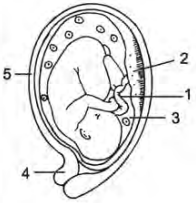
The diagram represents a developing human foetus in the womb. Study the same and then answer the questions that follow:
(i) Name the parts '1' to '5' indicated by guidelines.
(ii) What term is given to the period of development of the foetus in the womb?
(iii) Mention two functions of the part labelled as '2' other than its endocrine function.

Image
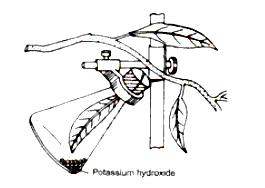
An experiment was set up as shown in the figure given below . The twig in the diagram was intact on the plant and it was as such in sunlight for a few hours .

(i) What is the aim of the above experiment ?
(ii) Why was potassium hydroxide placed inside the conical flask ?
(iii) What test would you perform on the leaf inside the flask?
(iv) What is the expected result of the above test ?
(v) Is it necessary to similarly test on outer leaf also ? Giva a reason .
Describe an experiment to prove that transpiration occurs more from the undersurface of dorsiventral leaves.
Explain the terms ‘adaptation’ and ‘accommodation’ with reference to the eye.
(i) Draw a neat and well-labelled diagram of the Chloroplast.
(ii) List the events taking place in the photo-chemical phase of Photosynthesis.
(iii) If you are planning an experiment to show the effect of light on photosynthesis :
(a) Will you select white light or green light? Justify your answer.
(b) Why would you select a destarched plant?
What does the term “double circulation” mean?
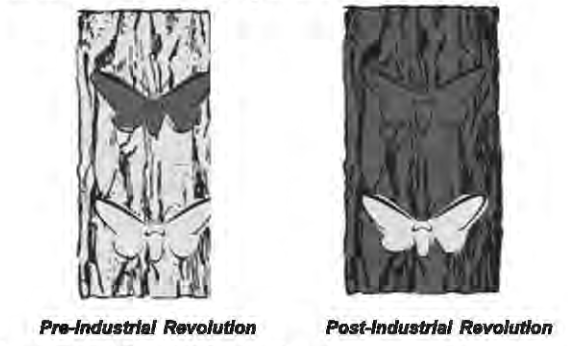
Study the picture given below and answer the questions:
Image

(i) Identify the phenomenon illustrated in the picture.
(ii) Write the scientific name of the insect which was involved in the phenomenon.
(iii) Which moth population was more post-industrialisation, light or dark? Provide an explanation.
Draw a diagram to display the vertical view of human female reproductive system and label the following parts in the diagram:
(1) Ureter
(2) Ovary
(3) Funnel of fallopian tube
(4) Urethra.
match the conditions in column A with the cause in column B.
A (Condition) B (Cause)
aDwarfism and mental retardation1shortage of glucose in blood
bDiabetes mellitus2Over secretion of growth hormone
cExcess of glucose in blood 3Insulin shock
dGigantism 4Over secretion of thyroxine
eEnlargement of breasts in adult males 5Hypothyroidism
fExophthalmic goitre 6Over secretion of cortical hormones
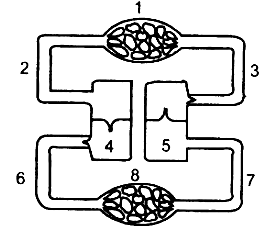
Given below is a simple diagram of the circulation of blood in a mammal showing the main blood vessels, the heart, lungs, and body tissues. The blood vessel labeled 6 contains deoxygenated blood and 2 the valve leading to it has three semi-lunar pockets.

(i) Name the blood vessels of organs marked by numbers 1 to 8.
(ii) What do you mean by the term ‘double circulation’ of blood in mammals?
(iii) What is diastole?