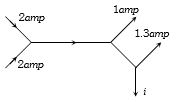
The figure below shows currents in a part of electric circuit. The current $i$ is ............. $amp$
Medium
Download our app for free and get started
According to Kirchhoff's first law
At junction $A$, ${i_{AB}} = 2 + 2 = 4\,A$
At junction $B$, ${i_{AB}} = {i_{BC}} - 1 = 3\,A$
At junction $C$, $i = {i_{BC}} - 1.3 = 3 - 1.3 = 1.7\,A$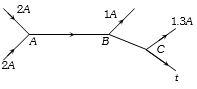

Download our appand get started for free
Experience the future of education. Simply download our apps or reach out to us for more information. Let's shape the future of learning together!No signup needed.*
Similar Questions
- 1Two uniform wires $A$ and $B$ are of the same metal and have equal masses. The radius of wire $A$ is twice that of wire $B$. The total resistance of A and $B$ when connected in parallel isView Solution
- 2In the circuit shown, the reading of the Ammeter is doubled after the switch is closed. Each resistor has a resistance $ = 1\,\Omega $ and the ideal cell has an $e.m.f. = 10\, V$. Then, the Ammeter has a coil resistance equal to ................ $\Omega$View Solution
- 3The current density is a solid cylindrical wire of radius $R ,$ as a function of radial distance $r$ is given by $J ( r )= J _{0}\left(1-\frac{ r }{ R }\right) .$ The total current in the radial region $r =0$ to $r =\frac{ R }{4}$ will beView Solution
- 4The resistance of a wire is $5 \Omega$. It's new resistance in ohm if stretched to $5$ times of it's original length will be :View Solution
- 5In the circuit diagram shown in figure given below, the current flowing through resistance $3\, \Omega$ is $\frac{ x }{3}\,A$. The value of $x$ is $...........$View Solution
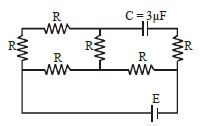
- 6In steady state the potential difference across the capacitor is $10\,\, V.$ Each resistance is of $3\,\Omega $. The cell is ideal. The $emf$ of the cell is .............. $\mathrm{V}$View Solution
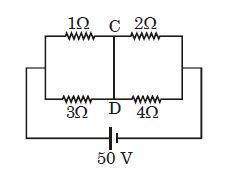
- 7In the given circuit diagram, find the current passing through wire $CD$ (in ampere)View Solution
- 8If a $30\, V$, $90\, W$ bulb is to be worked on a $120\, V$ line, a resistance of how many ohms should be connected in series with the bulb ............... $ohm$View Solution
- 9$A$ total charge $Q$ flows across a resistor $R$ during a time interval $= T$ in such a way that the current vs. time graph for $0 \rightarrow T$ is like the loop of a sin curve in the range $0 \rightarrow \pi$ . The total heat generated in the resistor isView Solution
- 10A $10\,V$ battery with internal resistance $1\,\Omega $ and a $15\,V$ battery with internal resistance $0.6\,\Omega $ are connected in parallel to a voltmeter (see figure). The reading in the voltmeter will be close to ................ $V$View Solution